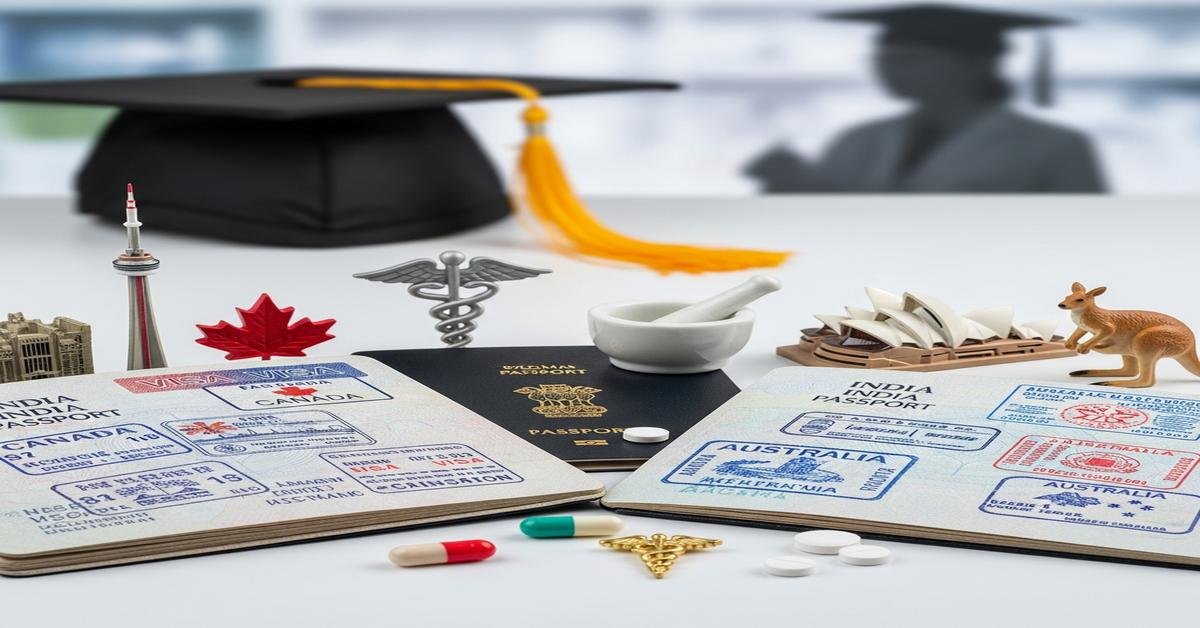
Moving from a B.Pharm or Pharm.D in India to pharmacist registration in Canada or Australia is doable, but it is not quick. Both countries test your knowledge, your practical skills, and your understanding of local laws before letting you serve patients. This guide breaks the process into clear steps, explains why each step matters, shows typical timelines and costs, and flags common mistakes. Use it to plan your path with fewer surprises.
What “registration” means and who regulates you
Registration is formal permission to practise as a pharmacist. It protects patients by confirming you can deliver safe, effective care in that country’s system.
- Canada: The Pharmacy Examining Board of Canada (PEBC) assesses your credentials and competence. Your licence is issued by a provincial college (for example, Ontario, British Columbia, Alberta). Each province adds its own requirements.
- Australia: The Australian Pharmacy Council (APC) assesses qualifications and exam readiness. The Pharmacy Board of Australia (through Ahpra) registers you. You must pass APC exams, then complete supervised practice and Board exams.
This split matters because exams are national, but licensing conditions (intern hours, language proof, law exams) can vary by province/state. Decide your destination early so you do not prepare for the wrong rules.
Canada: Step-by-step pathway for Indian graduates
-
Choose your province and immigration plan.
Licensing details differ. For example, Quebec requires French; internship hours vary elsewhere. Immigration status (permanent resident, work permit, or student) affects job options during training. Decide first to avoid redoing steps.
-
PEBC Document Evaluation (credential assessment).
Submit your B.Pharm/Pharm.D transcripts and degree directly from your university to PEBC, plus your identity documents. PEBC checks that your education is comparable to Canadian standards. This prevents you from investing in exams before your qualification is recognized.
-
Source verification of documents.
PEBC verifies your documents with the issuing institutions. This safeguards against fraud and is required before sitting later exams.
-
PEBC Evaluating Examination.
This exam tests foundational knowledge in pharmaceutics, pharmacology, therapeutics, calculations, and pharmacy practice. It confirms your baseline matches Canadian graduates. If your degree is older or your practice gaps are long, you may need extra study.
-
PEBC Qualifying Examination (MCQ + OSCE).
The multiple-choice component checks clinical reasoning and practice standards. The OSCE uses stations to simulate real practice (counselling, interventions, dose checks, ethics). This ensures you can apply knowledge safely, not just recall facts.
-
Apply for a provincial intern/student licence.
After passing PEBC requirements, you register as an intern with your chosen provincial college. This gives you legal authority to train under a preceptor.
-
Language proficiency.
Provinces require proof of English (or French in Quebec). Expect to show scores from recognized tests such as IELTS Academic or TOEFL iBT, unless you qualify for an exemption. Clear communication prevents medication errors, so this is non‑negotiable.
-
Jurisprudence (pharmacy law) exam.
You must pass the province’s law/ethics exam. Canadian pharmacy law covers scope of practice, controlled substances, billing, and privacy—local rules you must follow from day one.
-
Structured Practical Training (SPT) / Internship.
Complete supervised hours set by your province (often 600–1,000+ hours). This bridges the gap between what you did in India and how care is delivered in Canada (insurance systems, documentation, interdisciplinary teams, and dispensing platforms).
-
Final checks and full licence.
Submit criminal record checks, proof of professional liability insurance, and fees. After the college confirms all requirements, you receive your pharmacist licence.
Typical timeline: 12–24 months if you pass exams on first attempt and secure an internship promptly.
Indicative costs (subject to change): PEBC document evaluation and exams can total several thousand Canadian dollars. Add provincial fees, law exam fees, language tests, and costs for study materials. Budget for 8,000–15,000 CAD excluding living expenses.
Common mistakes to avoid:
- Studying only MCQs and neglecting OSCE communication and clinical reasoning.
- Delaying province choice; law exams and internship rules are province‑specific.
- Weak documentation: missing official transcripts or improper seals delay PEBC by months.
- Relying on immigration‑only English tests; your college may require different test types or band scores.
Practical tip: Work as a pharmacy assistant while preparing (where allowed). You will learn Canadian workflows, third‑party billing, and patient expectations, which helps in the OSCE and internship.
Australia: Step-by-step pathway for Indian graduates
-
Choose your pathway: KAPS vs CAOP.
Most Indian graduates take the KAPS exam (Knowledge Assessment of Pharmaceutical Sciences). Pharmacists with recent overseas registration and practice may be eligible for CAOP. Picking the right stream saves time.
-
APC eligibility and document assessment.
APC checks your degree, transcripts, and identity, and confirms your qualification meets Australian standards. This protects patients and ensures you are suitable for exams.
-
Pass the KAPS exam.
KAPS tests pharmaceutical chemistry/quality, pharmacology, pharmaceutics, and clinical therapeutics. It proves you have the core science and clinical base to practise safely in Australia.
-
English language skills.
For registration, you must meet the Pharmacy Board’s English standard (for example, IELTS Academic 7.0 in each band or OET B in each component; other tests are also accepted). High language standards are essential for counselling, documentation, and safety.
-
Apply for provisional registration (Ahpra).
With KAPS and English complete, you can register provisionally to begin supervised practice.
-
Secure an intern position and enrol in an Intern Training Program (ITP).
You must complete supervised practice hours and an approved ITP through a university or professional body. The ITP provides structured learning and assessments aligned with practice competencies.
-
Complete supervised practice (about 1,824 hours).
Usually around 48 weeks full-time. You will be assessed on dispensing accuracy, clinical interventions, counselling, and professional conduct. This step contextualizes your knowledge to Australian systems (PBS, electronic prescribing, privacy rules).
-
Pass the Pharmacy Board’s registration examinations.
These include a written exam and an oral assessment. They test real‑world decision‑making, safe dispensing, and professional judgement before full registration.
-
Obtain general registration.
After successful exams, supervised practice, and final checks (criminal history, recency of practice, professional indemnity insurance), Ahpra grants general registration.
-
Migration note.
The APC skills assessment also supports skilled migration points, but migration status and professional registration are separate processes. Plan both timelines if you aim for permanent residency.
Typical timeline: 12–18 months from KAPS to general registration if you secure an intern role quickly.
Indicative costs (subject to change): APC assessment and KAPS exam fees plus ITP tuition and Board exam fees commonly total 8,000–14,000 AUD, excluding living costs and English tests.
Common mistakes to avoid:
- Underestimating KAPS breadth; it spans both basic sciences and clinical therapeutics.
- Delaying English test preparation; you cannot progress to provisional registration without it.
- Waiting to job hunt; intern roles can be competitive in big cities. Apply widely, including regional areas.
Practical tip: During internship, log interventions and reflections weekly. Clear evidence speeds up competency sign‑off and helps in the oral exam.
Canada vs Australia: How to choose
- Exam profile: Canada emphasizes OSCE performance; strong communication and clinical reasoning are crucial. Australia emphasizes KAPS early; strong foundational science plus therapeutics are key.
- Internship length: Australia’s is about 48 weeks. Canadian provinces vary (often 600–1,000+ hours). If you want a faster internship, some Canadian provinces may be shorter.
- Language: Australia requires specific English bands for registration. Canada’s requirements vary by province; Quebec requires French.
- Job search: Big-city roles are competitive in both countries. Regional and rural sites often hire faster and can offer broader experience.
- Family and climate: Consider support networks and weather. Settling well helps you focus on exams.
Example: If you are confident in oral communication and patient counselling, Canada’s OSCE may suit you. If you excel in pharmaceutical sciences and structured written exams, Australia’s KAPS-first route may feel more predictable.
Documents checklist (both countries)
- Passport and recent passport‑size photos.
- B.Pharm/Pharm.D degree certificate.
- Official transcripts sent directly by your university.
- Internship/housemanship certificates (India), registration certificates (if registered), and letters of good standing.
- Name change/affidavit documents if applicable.
- Police clearance/criminal record checks (home country and destination).
- Language test results (IELTS Academic, OET, or other accepted tests as required).
- Curriculum vitae with exact dates to show recency of practice.
- Professional indemnity insurance (required before practice).
Study plans and realistic timelines
PEBC Evaluating + Qualifying (Canada) – 6 to 9 months:
- Months 1–2: Core therapeutics (cardio, endocrine, infectious diseases), law overview, calculations practice 20–30 min daily.
- Months 3–4: Expand to CNS, respiratory, GI, renal; practise Canadian guidelines and patient cases.
- Month 5: Full‑length MCQ mocks weekly; start OSCE drills (3–4 stations/day) with peers, focus on structure: introduce, assess, recommend, safety net, document.
- Months 6–7: Intensive OSCE role‑plays; record yourself for timing and clarity; refine SOAP notes and drug information responses.
- Final weeks: Mixed MCQ question banks, high‑yield calculations, law scenarios, rest strategy.
KAPS (Australia) – 3 to 5 months:
- Month 1: Pharmaceutical chemistry/quality assurance refresh; pharmaceutics (biopharmaceutics, dosage forms); daily calculations.
- Month 2: Pharmacology systems (ANS, cardiovascular, endocrine, CNS); summarise mechanisms and adverse effects.
- Month 3: Clinical therapeutics by condition; guideline‑based therapy choices; weekly mixed mocks.
- Month 4 (optional): Weak‑area deep dives; timed papers; error review logs.
- Ongoing: English practice (summarise an article aloud daily) to prepare for counselling and future oral exams.
Tip: Build a 1‑page “approach sheet” for counselling (structure, red flags, monitoring, lifestyle points). It speeds OSCE/oral prep and improves patient interactions during internship.
FAQs from Indian students
- Is an Indian B.Pharm accepted? Yes. Both countries assess your degree and your competence through exams. You do not need to redo your degree, but you must pass all assessments and complete supervised practice.
- What about Pharm.D (India)? Accepted for assessment. It may help with clinical content, but you still must pass the same exams and practice requirements.
- Can I skip English tests? Not if the regulator requires them. Patient safety depends on clear communication.
- Can I work while preparing? Often as a pharmacy assistant (not as a pharmacist) if your visa allows. This improves your understanding of local systems.
- How many attempts are allowed? There are limits and waiting periods for retakes. Failing repeatedly adds cost and delays. Plan structured study from the start.
- Hospital vs community jobs? Community positions are more numerous initially. Hospital roles are competitive and often expect local experience; build up with community, residency, or targeted internships.
Final planning checklist
- Pick your destination (province/state) and understand that regulator’s exact rules.
- Sequence your steps: credential assessment → knowledge exams → language → provisional/intern licence → supervised practice → law/oral exams → full registration.
- Build a budget and time buffer for retakes and document delays.
- Apply broadly for intern roles; consider regional locations for faster starts.
- Practise communication daily; it is the most common reason for OSCE/oral underperformance.
Becoming a registered pharmacist abroad is a project, not a sprint. If you plan early, document carefully, and practise both knowledge and communication, you will cross the finish line with confidence—in Canada or Australia.

