Introduction
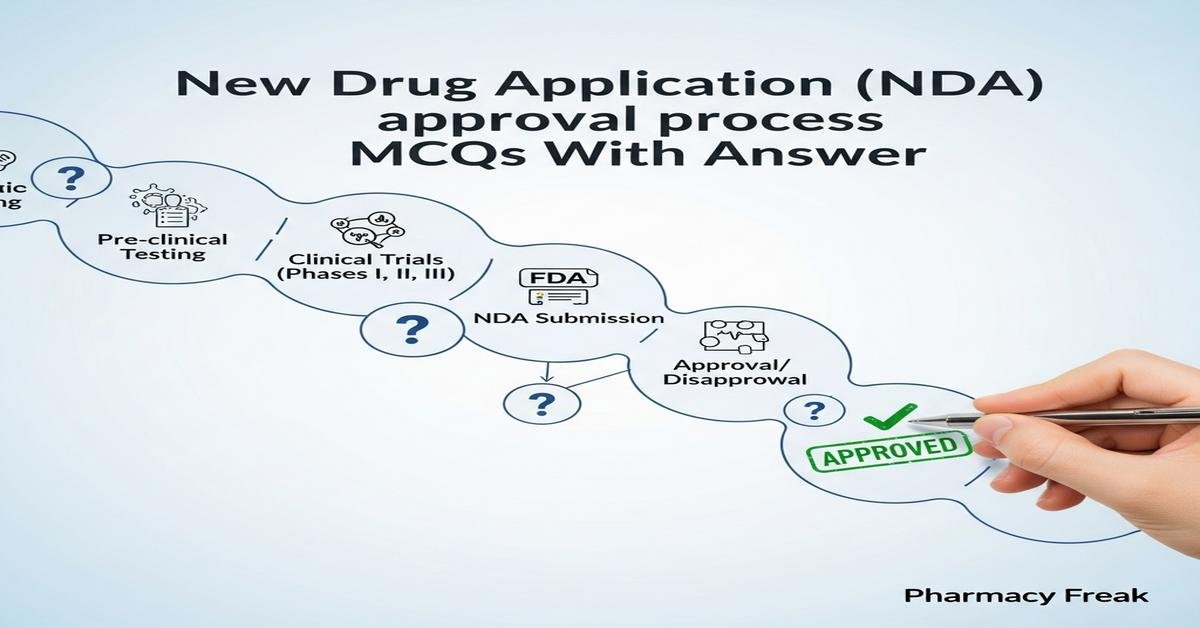
The New Drug Application (NDA) approval process is a critical regulatory pathway that B. Pharm students must understand to support drug development, regulatory submission, and market authorization. This topic covers NDA structure, Chemistry, Manufacturing and Controls (CMC), preclinical and clinical data requirements, Good Manufacturing Practices (GMP) inspections, FDA review timelines (PDUFA), safety and pharmacovigilance, labeling, and post-marketing obligations such as REMS and Phase IV studies. Familiarity with CTD format, regulatory designations (priority, breakthrough, orphan), and common regulatory outcomes (approval, complete response letter) prepares students for roles in regulatory affairs and quality assurance. Now let’s test your knowledge with 30 MCQs on this topic.
Q1. What does NDA stand for in regulatory submissions?
- New Drug Application
- Novel Development Accord
- National Drug Authorization
- New Development Allocation
Correct Answer: New Drug Application
Q2. Which US agency is responsible for reviewing NDAs?
- European Medicines Agency (EMA)
- Food and Drug Administration (FDA)
- World Health Organization (WHO)
- Centers for Disease Control and Prevention (CDC)
Correct Answer: Food and Drug Administration (FDA)
Q3. Which submission typically precedes an NDA and allows clinical trials in humans?
- Biologics License Application (BLA)
- Investigational New Drug (IND) application
- Abbreviated New Drug Application (ANDA)
- Marketing Authorization Application (MAA)
Correct Answer: Investigational New Drug (IND) application
Q4. Under PDUFA goals, what is the FDA review timeframe for a standard NDA?
- 3 months
- 6 months
- 10 months
- 24 months
Correct Answer: 10 months
Q5. In NDA content, what does CMC refer to?
- Clinical Monitoring and Compliance
- Chemistry, Manufacturing, and Controls
- Clinical, Medical, and Commercial
- Compound, Mechanism, and Composition
Correct Answer: Chemistry, Manufacturing, and Controls
Q6. Which regulatory pathway allows reliance on published literature or another product’s data for approval?
- 505(b)(1) full NDA
- 505(b)(2) hybrid application
- 505(j) ANDA for generics
- Biologics License Application (BLA)
Correct Answer: 505(b)(2) hybrid application
Q7. What is the primary purpose of FDA advisory committees during NDA review?
- To draft final labeling text
- To provide independent expert advice on complex issues
- To conduct on-site manufacturing inspections
- To set user fee amounts under PDUFA
Correct Answer: To provide independent expert advice on complex issues
Q8. When is a Risk Evaluation and Mitigation Strategy (REMS) typically required?
- For all generic drug approvals
- When a drug’s benefits outweigh risks but special risk management is needed
- Only for over-the-counter products
- When a product has no known adverse effects
Correct Answer: When a drug’s benefits outweigh risks but special risk management is needed
Q9. Which phase of clinical trials usually supplies pivotal efficacy data submitted in an NDA?
- Phase I
- Phase II
- Phase III
- Phase IV
Correct Answer: Phase III
Q10. Which application type primarily requires bioequivalence studies rather than full clinical efficacy trials?
- 505(b)(1) NDA for NCEs
- 505(b)(2) hybrid NDA
- 505(j) Abbreviated New Drug Application (ANDA)
- Biologics License Application (BLA)
Correct Answer: 505(j) Abbreviated New Drug Application (ANDA)
Q11. What is a “pivotal trial” in the context of NDA submissions?
- A small safety trial in healthy volunteers
- An exploratory pharmacology study
- A definitive trial intended to provide substantial evidence of efficacy
- A post-marketing observational study
Correct Answer: A definitive trial intended to provide substantial evidence of efficacy
Q12. Which CFR part primarily governs FDA drug approval procedures for NDAs?
- 21 CFR Part 312
- 21 CFR Part 314
- 21 CFR Part 600
- 21 CFR Part 820
Correct Answer: 21 CFR Part 314
Q13. Which US law requires pediatric study plans for certain new drug applications?
- Orphan Drug Act
- Pediatric Research Equity Act (PREA)
- Food, Drug, and Cosmetic Act (FD&C) only
- Drug Listing Act
Correct Answer: Pediatric Research Equity Act (PREA)
Q14. For CMC stability data in an NDA, regulators typically expect stability studies on how many production-scale batches?
- One batch
- Two batches
- Three batches
- Ten batches
Correct Answer: Three batches
Q15. Which report documents FDA findings after an inspection of a manufacturing site?
- Investigational Brochure
- Establishment Inspection Report (EIR)
- Clinical Study Report (CSR)
- Risk Management Plan (RMP)
Correct Answer: Establishment Inspection Report (EIR)
Q16. What does a Complete Response Letter (CRL) from FDA indicate?
- Immediate approval with conditions
- Approval for marketing outside the US only
- FDA cannot approve the application in its present form
- An automatic priority review has been granted
Correct Answer: FDA cannot approve the application in its present form
Q17. Under PDUFA, what is the purpose of user fees paid by applicants?
- To fund marketing activities for the product
- To support FDA review resources and timelines
- To guarantee approval of applications
- To pay clinical trial participants
Correct Answer: To support FDA review resources and timelines
Q18. In the CTD format, which module contains quality (CMC) information?
- Module 1
- Module 2
- Module 3
- Module 5
Correct Answer: Module 3
Q19. How many years of market exclusivity does orphan drug designation grant in the US after approval?
- 3 years
- 5 years
- 7 years
- 10 years
Correct Answer: 7 years
Q20. Which designation shortens review time and facilitates more frequent FDA interactions to expedite development?
- Orphan drug designation
- Priority review
- Fast Track designation
- Standard review
Correct Answer: Fast Track designation
Q21. What is required for Breakthrough Therapy designation?
- Demonstration of superiority in post-marketing studies only
- Preliminary clinical evidence of substantial improvement over existing therapies
- Only nonclinical animal data showing activity
- Application for a generic equivalent
Correct Answer: Preliminary clinical evidence of substantial improvement over existing therapies
Q22. Which of the following is NOT typically an element of a REMS?
- Medication Guide
- Communication Plan
- Elements to Assure Safe Use (ETASU)
- Pharmacovigilance Plan
Correct Answer: Pharmacovigilance Plan
Q23. What formal meeting is often requested before NDA submission to clarify FDA expectations?
- Pre-IND meeting
- Pre-NDA (Type B) or pre-submission meeting
- Post-marketing surveillance meeting
- GMP remediation meeting
Correct Answer: Pre-NDA (Type B) or pre-submission meeting
Q24. Where in an NDA is the proposed prescribing information (labeling) submitted?
- As part of the clinical study reports only
- Under the labeling section of the application
- Only after approval
- Within the nonclinical toxicology module
Correct Answer: Under the labeling section of the application
Q25. Which approval pathway often requires confirmatory post-marketing (Phase IV) trials as a condition of approval?
- Standard approval without conditions
- Accelerated approval
- 505(j) ANDA pathway
- Over-the-counter monograph process
Correct Answer: Accelerated approval
Q26. Which ICH guideline primarily addresses stability testing for drug substances and products?
- ICH Q7
- ICH Q1A
- ICH E6
- ICH M4
Correct Answer: ICH Q1A
Q27. Which clinical phase is primarily focused on initial human safety and pharmacokinetics?
- Phase I
- Phase II
- Phase III
- Phase IV
Correct Answer: Phase I
Q28. What is the correct submission type to request approval for a new indication of an already approved drug?
- Initial NDA (original application)
- Supplemental NDA (sNDA)
- ANDA
- IND
Correct Answer: Supplemental NDA (sNDA)
Q29. How many years of data exclusivity are granted to a new chemical entity (NCE) in the US?
- 3 years
- 5 years
- 7 years
- 12 years
Correct Answer: 5 years
Q30. Which activity commonly occurs before FDA grants approval of an NDA to verify manufacturing compliance?
- Advertising campaign approval
- Good Manufacturing Practice (GMP) inspection of the manufacturing facility
- Final pricing negotiation with CMS
- Market exclusivity determination by USP
Correct Answer: Good Manufacturing Practice (GMP) inspection of the manufacturing facility


