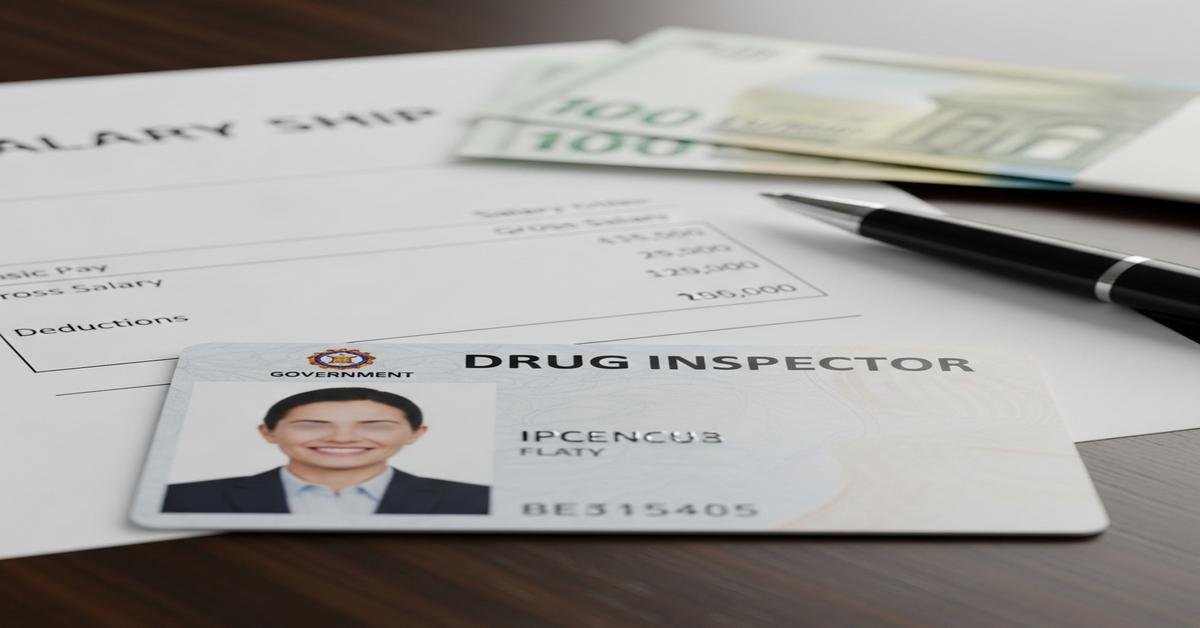
People imagine a Drug Inspector as a “raid officer with a lot of power.” The truth is more balanced: the job mixes scientific inspection with legal enforcement, routine paperwork with sudden emergencies—and the pay is good for a mid-career government role. Below is a clear, numbers-first look at the real salary, allowances, power, and lifestyle of a Drug Inspector in India (both Central and State cadres), plus sample pay slips so you know what lands in hand and why.
The post, responsibility, and real power
A Drug Inspector is a statutory officer under the Drugs and Cosmetics Act, 1940 (and Rules). The law grants inspection and enforcement powers for drug manufacture, sale, and distribution. This isn’t symbolic authority; it has teeth because public health is at stake.
- What they inspect: Manufacturing units, wholesalers, retailers, hospitals, blood banks, and sometimes medical device units (where notified).
- Legal powers: Enter and inspect premises, examine records, draw samples, seize stocks, and send samples to government labs. They can initiate prosecutions and issue stop-sale or stop-manufacture recommendations. Arrests, if needed, are executed with police support because criminal procedure applies.
- Why this matters: Poor-quality or spurious drugs can kill. The inspector’s decisions—what to sample, when to seize, whether to prosecute—directly shape compliance behavior in the pharma supply chain.
Core pay: where a Drug Inspector sits in the pay matrix
Most Drug Inspector posts (Central and State) are equivalent to Pay Matrix Level-7 under the 7th CPC, which has a basic pay starting at ₹44,900 and progressing up to ₹1,42,400 with increments.
- Central (CDSCO): Typically Level-7, Group B (Gazetted). Basic starts at ₹44,900.
- States: Usually aligned to Level-7 equivalent in the state’s pay matrix; some states may grant slightly higher levels or special allowances based on local policy.
Why “basic” matters: Almost every allowance (HRA, DA, NPS, TA uplift) is calculated from your basic pay. That’s why a Level-7 start is meaningful: it sets the floor for everything else.
Allowances that shape the real (gross) salary
Allowances exist to offset real costs—price inflation, housing, and commuting. They are revised by formula, not whim, which is why you’ll see predictable jumps through the year.
- Dearness Allowance (DA): Compensates for inflation. Revised twice a year. For illustration, if DA is 50% and your basic is ₹44,900, DA is ₹22,450.
- House Rent Allowance (HRA): Depends on city class. At DA up to 50%, HRA is typically 27% (X city), 18% (Y), or 9% (Z). When DA crosses 50%, HRA steps up to 30/20/10. This ties rent support to inflation levels.
- Transport Allowance (TA): For Level 1–8, common slabs are ₹3,600 + DA (in big cities with transport infrastructure, often called TPTA cities) and ₹1,800 + DA (other places). The “+ DA” part keeps commuting support inflation-proof.
- Tour TA/DA: When on inspection tours, you get daily allowance and travel reimbursement as per rules. This acknowledges that fieldwork has real out-of-pocket costs.
Standard deductions you will see
Deductions are not “losses”; most are savings or statutory contributions that come back as retirement or risk cover.
- NPS (Employee): 10% of (Basic + DA). This builds your retirement corpus. The government also contributes 14%, which is not part of your in-hand pay but is a real benefit.
- Income Tax (TDS): Depends on your chosen regime and annual taxable income. Not a fixed monthly number; payroll adjusts it through the year.
- Group Insurance / Welfare Funds: Central Group B employees typically see a small monthly Group Insurance deduction. States have their own GIS/GPF/medical schemes.
- Professional Tax: In many states, up to ₹200 per month depending on slab.
Sample pay slip: Central Drug Inspector (Level-7, starting)
Assumptions: Basic ₹44,900; DA 50%; HRA at 27% (X city); TA ₹3,600 + DA; standard deductions, no special claims this month.
- Earnings
- Basic Pay: ₹44,900
- DA (50%): ₹22,450
- HRA (27% of basic): ₹12,123
- Transport Allowance: ₹3,600
- DA on TA (50%): ₹1,800
- Gross: ₹84,873
- Deductions
- NPS (10% of Basic + DA): ₹6,735
- Group Insurance (indicative): ₹60
- Professional Tax (if applicable): ₹200
- Income Tax (example): varies; assume ₹2,000 for illustration
- Total Deductions (illustrative): ~₹8,995
- Net (in-hand, illustrative): ~₹75,900
Why this is “illustrative”: DA/HRA slabs change with inflation; TDS depends on your regime/investments; some months include tour claims or arrears.
Sample pay slip: State Drug Inspector (Level-7 equivalent, Class A city)
Assumptions: Basic ₹44,900; DA same as state notification; HRA at state’s X-city rate; TA slabs similar; state-specific deductions.
- Earnings
- Basic: ₹44,900
- DA (assume 50% for parity): ₹22,450
- HRA (state X-city, assume 27%): ₹12,123
- TA + DA component: ~₹5,400
- Gross: ~₹84,873
- Deductions
- NPS (10% of Basic + DA): ₹6,735
- State GIS/Insurance: typical ₹50–₹200
- Professional Tax: up to ₹200
- Income Tax (example): varies; assume ₹2,000
- Total Deductions (illustrative): ~₹9,000–₹9,200
- Net (in-hand, illustrative): ~₹75,500–₹75,800
Why states differ: HRA categorization, medical scheme contributions, and professional tax slabs vary by state. The core Level-7 base keeps the structure similar.
Perks that don’t show fully in-hand
- NPS (Employer 14%): Paid by government into your retirement corpus. This is a major long-term benefit.
- Medical facilities: Central employees may opt for CGHS; states have their own panels or reimbursement rules. The value shows when you face a large medical bill.
- LTC (Leave Travel Concession): Periodic travel reimbursement for self and family within rules.
- Accommodation or HRA: In cities with limited government housing, HRA is the default; some get quarters if available.
- Training and certification: GMP, GDP, medical device regulations, and legal procedure trainings enhance career value.
- Tour entitlements: Daily allowance, mileage/transport reimbursement for inspections and raids.
Workday, field realities, and lifestyle
Expect a mixed schedule: office file work, court dates, and field inspections. The rhythm is not 100% predictable because emergencies happen.
- Routine: Inspections, sample documentation, lab coordination, license scrutiny, replies to representations, and periodic meetings.
- Unplanned: Complaints, adverse events, spurious drug alerts, and joint raids with police or local administration.
- Courtwork: Filing complaints, evidence, attending cross-examination. Cases can run long; your documentation must withstand courtroom scrutiny. This is why meticulous sampling and panchnama matter.
- Travel: Frequent within district/region; occasional outstation. TA/DA cushions the cost but it is time on the road.
Lifestyle: In-hand pay supports a comfortable middle-class life. In metros, rent bites but HRA and predictable increments help. In smaller towns, disposable income is higher and commute stress lower. Work-life balance is reasonable most weeks, but raids and court dates can stretch hours. Transfers occur, usually within the state for state cadres and across zones for the Centre.
How authority is exercised (and limited)
Drug Inspectors are powerful within the narrow lane of drug regulation. They are not a general-purpose law-and-order force.
- They can: Search, seize, sample, summon records, issue notices, recommend license actions, and prosecute under the Act.
- They cannot: Act outside the statute, conduct arbitrary arrests, or shut businesses without procedure. Due process is not optional—it protects both public and officer.
- Why this balance: The system aims to protect health without stifling legitimate industry. Abuse of power backfires in court and erodes credibility.
Promotion ladder and long-term growth
Growth is steady because expertise deepens with casework and inspections.
- Central track: Drug Inspector → Senior Drug Inspector → Assistant Drugs Controller → Deputy/Joint Drugs Controller → Additional/Drugs Controller.
- State track: Drug Inspector → Senior/Circle/Assistant Drugs Controller → Deputy/Joint → State Drugs Controller.
- Why growth is paced: Vacancies depend on sanctioned strength and retirements. Technical credibility, training, and clean case records speed competitive postings.
Realistic pros and cons
- Pros: Public-impact work, stable salary with inflation protection, field exposure, legal experience, and clear career path.
- Cons: Documentation load, court delays, industry pressure, and occasional resource constraints (lab backlogs, vehicle availability).
Reading your own pay slip: quick checklist
- Match the math: DA should be the notified percentage of basic. HRA must match city category and current DA slab.
- TA correctness: Check base TA slab and DA on TA.
- NPS split: Employee 10% deducted; employer 14% shown separately in your statement, not in-hand.
- TDS reasonableness: If your investments or tax regime change, inform DDO so TDS adjusts early.
- Arrears and claims: Tour claims, leave encashment, and arrears may post late; keep your TA diaries and orders tight.
The bottom line
Salary: A starting Drug Inspector at Level-7 typically takes home around ₹75,000 per month in a metro under current DA/HRA assumptions, with steady increments and strong retirement benefits via NPS. Power: Significant within drug law—enough to stop bad drugs and prosecute—but bounded by due process. Lifestyle: Middle-class, stable, field-heavy, and meaningful if you like science plus law. If you value impact and procedure over glamour, this role fits well—and pays fairly for it.

