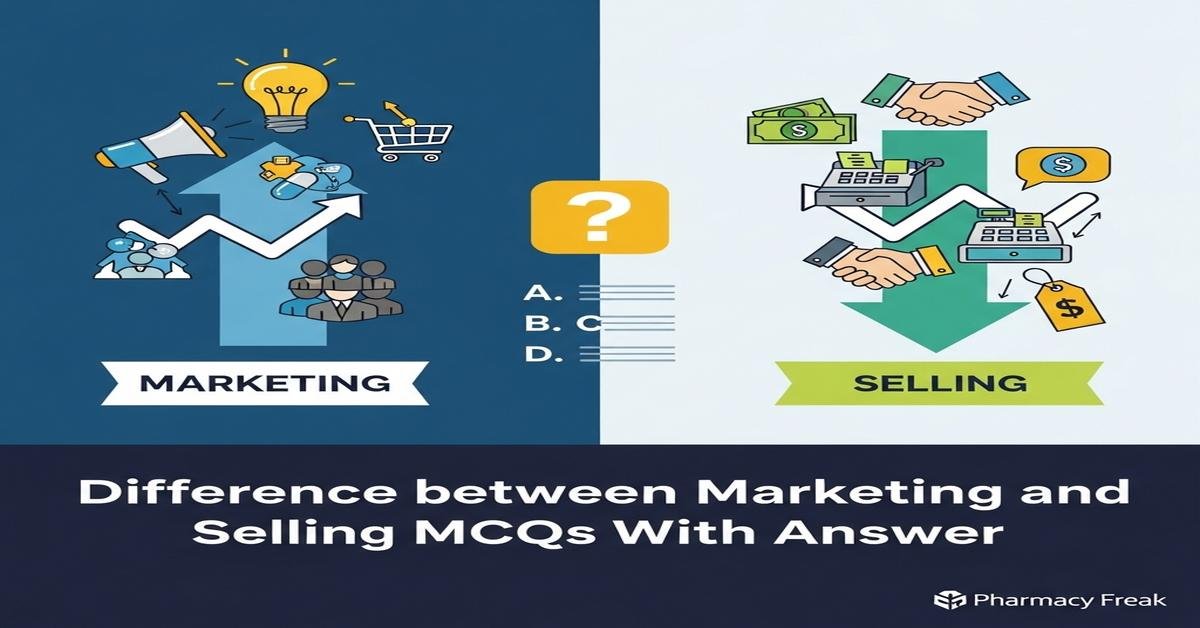
Understanding the difference between marketing and selling is essential for B.Pharm students entering pharmaceutical marketing, sales, regulatory affairs, or product management. Marketing is a strategic, customer-oriented process involving market research, segmentation, product development, pricing, distribution, promotion, and post-launch monitoring to meet patient and healthcare provider needs. Selling is a tactical, transaction-focused activity emphasizing personal persuasion, negotiation, and closing deals to achieve short-term sales targets. In pharmaceuticals, ethical compliance, evidence-based promotion, brand management, and relationship-building with healthcare professionals define how marketing and selling work together. This overview clarifies objectives, scope, strategies, and examples relevant to pharmacy practice. Now let’s test your knowledge with 30 MCQs on this topic.
Q1. What is the primary focus of marketing compared to selling?
- Maximizing short-term sales through persuasion
- Creating long-term customer value and meeting needs
- Managing inventory and logistics
- Providing discounts to achieve targets
Correct Answer: Creating long-term customer value and meeting needs
Q2. Which activity is most associated with selling in the pharmaceutical industry?
- Conducting market segmentation
- Developing product life-cycle strategy
- Detailing to physicians and closing orders
- Setting long-term brand positioning
Correct Answer: Detailing to physicians and closing orders
Q3. Which of the following best describes a marketing function?
- One-on-one promotional visits by sales reps
- Analyzing patient needs and competitor products
- Collecting cash from orders
- Negotiating price discounts with distributors
Correct Answer: Analyzing patient needs and competitor products
Q4. Time orientation distinguishes marketing from selling. Marketing is typically:
- Short-term and transactional
- Long-term and strategic
- Irrelevant to product development
- Only concerned with distribution
Correct Answer: Long-term and strategic
Q5. In the marketing mix, which ‘P’ is most directly associated with selling tactics?
- Product
- Price
- Place
- Promotion
Correct Answer: Promotion
Q6. Which statement reflects a selling-oriented company approach?
- Design products based on market research
- Focus on aggressive promotion to move existing stock
- Invest in long-term patient education programs
- Segment markets by therapeutic need
Correct Answer: Focus on aggressive promotion to move existing stock
Q7. In pharmaceutical marketing, ‘pull’ strategies primarily aim to:
- Create demand among healthcare providers and patients
- Increase distributor inventory through incentives
- Train sales reps to close orders
- Reduce manufacturing costs
Correct Answer: Create demand among healthcare providers and patients
Q8. Which metric is more marketing-focused than selling-focused?
- Daily sales calls completed
- Sales volume this month
- Market share and brand equity
- Number of orders closed
Correct Answer: Market share and brand equity
Q9. Market research in pharmaceuticals helps marketers to:
- Only increase order frequency
- Understand unmet medical needs and target segments
- Calculate commissions for sales staff
- Decide shipment schedules
Correct Answer: Understand unmet medical needs and target segments
Q10. Which activity demonstrates ethical marketing in pharma?
- Offering gifts to influence prescriptions
- Providing evidence-based educational materials to clinicians
- Misrepresenting clinical data to increase uptake
- Pressuring wholesalers to buy excess stock
Correct Answer: Providing evidence-based educational materials to clinicians
Q11. A sales function typically measures success by:
- Brand recognition in target patient groups
- Long-term adherence rates
- Number of prescriptions or units sold
- Quality of marketing research reports
Correct Answer: Number of prescriptions or units sold
Q12. Which is a key difference in orientation between marketing and selling?
- Marketing is product-centered; selling is customer-centered
- Both have identical goals and methods
- Marketing is customer-centered; selling is transaction-centered
- Selling replaces marketing in ethical contexts
Correct Answer: Marketing is customer-centered; selling is transaction-centered
Q13. Positioning a new drug in the market is primarily a:
- Selling activity performed during each call
- Marketing responsibility involving strategy and messaging
- Logistics task handled by distribution
- Regulatory approval process
Correct Answer: Marketing responsibility involving strategy and messaging
Q14. Which approach is more likely to improve long-term patient adherence?
- High-pressure sales tactics
- Educational marketing and support programs
- One-time discount coupons
- Restricting access to competitors
Correct Answer: Educational marketing and support programs
Q15. In a product launch, the marketing team is mainly responsible for:
- Closing immediate hospital orders
- Designing launch strategy, target audience and messaging
- Counting delivered samples only
- Negotiating distributor credit terms exclusively
Correct Answer: Designing launch strategy, target audience and messaging
Q16. Consultative selling in pharma emphasizes:
- Only pushing promotions to reach quota
- Understanding clinician needs and recommending solutions
- Reducing manufacturing costs
- Focusing solely on price reductions
Correct Answer: Understanding clinician needs and recommending solutions
Q17. Which is an example of a selling tool rather than a marketing tool?
- Segmentation matrix
- Promotional leave-behind materials for reps
- Market demand forecast models
- Patient journey mapping
Correct Answer: Promotional leave-behind materials for reps
Q18. Relationship marketing in pharmaceuticals focuses on:
- Short-term transaction maximization
- Building trust and long-term relationships with HCPs and patients
- Only reducing price for repeat customers
- One-time sampling campaigns
Correct Answer: Building trust and long-term relationships with HCPs and patients
Q19. Which regulatory concern affects both marketing and selling in pharma?
- Good Laboratory Practice only
- Accurate representation of clinical evidence and compliant promotion
- Warehouse shelving arrangements
- Vehicle maintenance for sales reps
Correct Answer: Accurate representation of clinical evidence and compliant promotion
Q20. A marketing segmentation strategy is important because it:
- Ensures identical messaging to all audiences
- Helps tailor products and communication to specific clinician or patient groups
- Eliminates the need for sales representatives
- Only benefits manufacturing
Correct Answer: Helps tailor products and communication to specific clinician or patient groups
Q21. Which describes a ‘push’ strategy often used by sales teams?
- Direct-to-consumer advertising to create patient demand
- Encouraging distributors and retailers to stock and promote the product
- Publishing peer-reviewed clinical trials
- Creating disease awareness campaigns
Correct Answer: Encouraging distributors and retailers to stock and promote the product
Q22. Which is a marketing responsibility during post-marketing surveillance?
- Executing daily sales calls
- Monitoring real-world drug performance and adverse event trends
- Delivering invoices to hospitals
- Managing truck routes
Correct Answer: Monitoring real-world drug performance and adverse event trends
Q23. Which activity helps sales convert leads generated by marketing?
- Field-based clinical detailing and follow-up
- Running market research surveys
- Analyzing prescription databases only
- Developing global pricing policy
Correct Answer: Field-based clinical detailing and follow-up
Q24. Brand equity in pharmaceuticals is built mainly through:
- Repeated price discounts
- Consistent quality, evidence-based communication, and trust
- Only high-volume sales calls
- Reducing regulatory oversight
Correct Answer: Consistent quality, evidence-based communication, and trust
Q25. Which is a common KPI for sales teams but not for marketing teams?
- Prescription growth rate
- Number of scientific engagements organized
- Leads generated from campaigns
- Brand awareness index
Correct Answer: Prescription growth rate
Q26. Which pricing approach is more of a marketing decision in pharma?
- Setting price solely to meet monthly quota
- Value-based pricing aligned to therapeutic benefit and payer willingness
- Giving ad-hoc discounts to preferred customers
- Setting price to clear obsolete inventory
Correct Answer: Value-based pricing aligned to therapeutic benefit and payer willingness
Q27. Which technique demonstrates integration of marketing and selling?
- Marketing develops educational materials; sales use them during detailing
- Marketing works alone without sales input
- Sales ignores marketing campaigns and creates their own scripts
- Marketing only focuses on manufacturing
Correct Answer: Marketing develops educational materials; sales use them during detailing
Q28. Which describes an ethical risk when selling pharmaceutical products?
- Providing scientifically accurate data to clinicians
- Offering inappropriate inducements to influence prescribing
- Conducting compliant medical education programs
- Engaging patients with adherence support services
Correct Answer: Offering inappropriate inducements to influence prescribing
Q29. When launching a new generic in a crowded market, marketing should prioritize:
- Short-term aggressive discounts only
- Differentiation, target segments, and value communication
- Avoiding competitor analysis
- Refusing to work with pharmacists
Correct Answer: Differentiation, target segments, and value communication
Q30. Which best summarizes the relationship between marketing and selling?
- They are identical and interchangeable
- Selling is a subset of marketing that executes tactics to realize marketing strategy
- Marketing should be eliminated in favor of selling
- Both operate without any coordination
Correct Answer: Selling is a subset of marketing that executes tactics to realize marketing strategy


