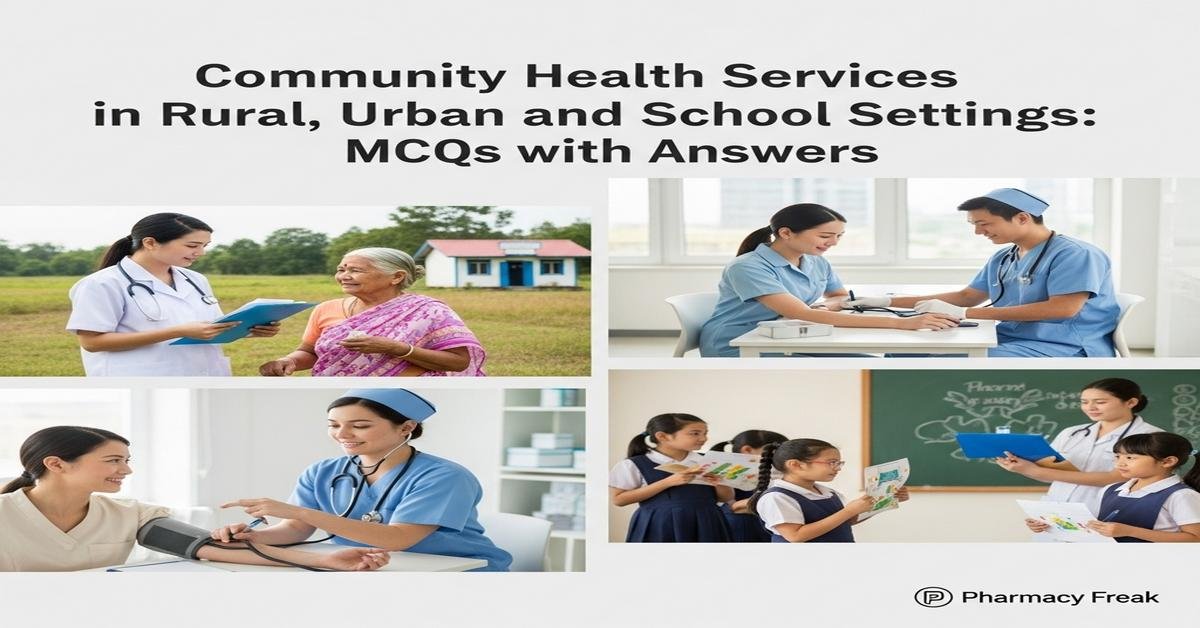
Community health services in rural, urban and school settings cover a wide range of primary healthcare activities essential for B. Pharm students to understand. These services include health promotion, disease prevention, immunization, maternal and child care, communicable and non-communicable disease screening, medication management, cold chain maintenance, pharmacovigilance and community-based rehabilitation. Understanding differences between rural and urban delivery, roles of frontline workers, school health programs and referral linkages helps pharmacists contribute to public health, rational drug use and patient counseling. Keywords: community health services, rural health, urban health, school health, immunization, primary healthcare, public health, preventive care, pharmacovigilance.
Now let’s test your knowledge with 30 MCQs on this topic.
Q1. Which component is central to community health services and emphasizes prevention, health promotion and basic curative care?
- Specialized tertiary care services
- Primary healthcare services
- Hospital-based inpatient care
- Advanced surgical interventions
Correct Answer: Primary healthcare services
Q2. Which of the following is a key difference between rural and urban community health services?
- Only rural areas require immunization programs
- Urban areas always have better cold chain management
- Rural areas often face limited access to health professionals and infrastructure
- Urban areas lack any primary healthcare centers
Correct Answer: Rural areas often face limited access to health professionals and infrastructure
Q3. In school health programs, which activity is commonly included for early detection of health issues?
- Comprehensive inpatient treatment
- Periodic screening for vision, hearing and growth
- Only vaccinations without screening
- Advanced laboratory diagnostics onsite
Correct Answer: Periodic screening for vision, hearing and growth
Q4. Which frontline worker is primarily associated with delivering maternal and child health services at the community level in India?
- Medical Officer
- Accredited Social Health Activist (ASHA)
- Cardiologist
- Radiologist
Correct Answer: Accredited Social Health Activist (ASHA)
Q5. Pharmacovigilance in community settings primarily aims to:
- Increase sales of medicines
- Detect, assess and prevent adverse drug reactions
- Provide surgical care in villages
- Limit vaccination coverage
Correct Answer: Detect, assess and prevent adverse drug reactions
Q6. Which cold chain practice is essential for maintaining vaccine potency at peripheral health centers?
- Storing vaccines at room temperature indefinitely
- Using unauthorized freezers without monitoring
- Maintaining recommended temperature range with temperature monitors
- Mixing different vaccine vials in one container
Correct Answer: Maintaining recommended temperature range with temperature monitors
Q7. A key indicator for assessing maternal health services at community level is:
- Number of MRI scans performed
- Proportion of pregnant women receiving at least four antenatal visits
- Total number of private clinics in an area
- Number of cosmetic procedures
Correct Answer: Proportion of pregnant women receiving at least four antenatal visits
Q8. Which program focuses on tuberculosis control through community-based DOTS and surveillance?
- National Malaria Elimination Programme (NMEP)
- Revised National Tuberculosis Control Program (RNTCP) / NTEP
- National Vector Borne Disease Control Programme
- Universal Immunization Programme (UIP)
Correct Answer: Revised National Tuberculosis Control Program (RNTCP) / NTEP
Q9. In urban health settings, a major challenge for community pharmacists is:
- Complete absence of patients
- Managing polypharmacy and over-the-counter misuse
- Only dealing with veterinary medicines
- No involvement in public health activities
Correct Answer: Managing polypharmacy and over-the-counter misuse
Q10. School-based deworming primarily contributes to:
- Reduced cognitive and growth development
- Increased prevalence of anemia
- Improved nutritional status and reduced parasitic burden
- Higher rates of hospital admission
Correct Answer: Improved nutritional status and reduced parasitic burden
Q11. Which immunization schedule concept is crucial for community health service planning?
- Single-dose lifetime vaccination for all diseases
- Age-appropriate and timely vaccination according to national schedule
- Vaccination only for adults
- Giving all vaccines regardless of contraindications
Correct Answer: Age-appropriate and timely vaccination according to national schedule
Q12. The role of a pharmacist in community health outreach includes:
- Only dispensing medicines without counseling
- Health education, medication review, immunization support and ADR reporting
- Performing surgical procedures in the field
- Providing diagnostic imaging services
Correct Answer: Health education, medication review, immunization support and ADR reporting
Q13. Which surveillance activity is essential at community level for early outbreak detection?
- Active case finding and reporting of notifiable diseases
- Only tertiary care laboratory surveillance
- Ignoring unusual clusters of illness
- Surveillance limited to vaccine stocks
Correct Answer: Active case finding and reporting of notifiable diseases
Q14. For non-communicable disease (NCD) screening in the community, pharmacists can participate by:
- Prescribing insulin without training
- Conducting blood pressure and blood glucose screening and counselling
- Only selling over-the-counter painkillers
- Performing complex surgeries
Correct Answer: Conducting blood pressure and blood glucose screening and counselling
Q15. In rural immunization outreach, which logistical factor must be planned carefully?
- Distance to tertiary hospital for cosmetic care
- Transport and maintenance of vaccine cold chain during outreach
- Availability of luxury accommodations for health workers
- Irrelevant promotional events
Correct Answer: Transport and maintenance of vaccine cold chain during outreach
Q16. Which health education strategy is most effective in community settings?
- Using complex medical jargon with no visuals
- Culturally appropriate, interactive and locally tailored messaging
- One-time lecture without follow-up
- Only distributing dense technical pamphlets
Correct Answer: Culturally appropriate, interactive and locally tailored messaging
Q17. Which essential medicine concept is most relevant for community pharmacies?
- Stocking all available brand-name products regardless of need
- Ensuring availability of an essential medicines list based on local burden and affordability
- Keeping only injectable medications
- Importing rare investigational drugs for routine use
Correct Answer: Ensuring availability of an essential medicines list based on local burden and affordability
Q18. During a measles outbreak in a rural school, a priority community action is:
- Stopping all communications with health authorities
- Conducting case identification, isolation, and intensified immunization (SIAs)
- Only treating with antibiotics at home
- Removing vaccines from the area
Correct Answer: Conducting case identification, isolation, and intensified immunization (SIAs)
Q19. Which indicator helps evaluate immunization program performance at community level?
- Number of private hospitals built
- Cold chain brand popularity
- Proportion of children fully immunized by age one year
- Amount of advertising for vaccines
Correct Answer: Proportion of children fully immunized by age one year
Q20. In school settings, medication administration policies should emphasize:
- Unsupervised student self-administration of prescription antibiotics
- Clear parental consent, documentation and trained staff for administration
- Storing all medicines in unlocked lockers
- Dispensing narcotics to students on request
Correct Answer: Clear parental consent, documentation and trained staff for administration
Q21. Which community-level intervention reduces diarrheal disease burden among children?
- Promoting open defecation
- Improving water, sanitation, hand hygiene and rotavirus vaccination
- Discouraging breastfeeding
- Exclusive reliance on antibiotics without prevention
Correct Answer: Improving water, sanitation, hand hygiene and rotavirus vaccination
Q22. For pharmacovigilance reporting from a primary health center, which system is commonly used in India?
- WHO-ART only in hospitals
- Pharmacovigilance Program of India (PvPI) reporting using Suspected ADR forms
- Non-standard verbal reports without forms
- Only social media posts
Correct Answer: Pharmacovigilance Program of India (PvPI) reporting using Suspected ADR forms
Q23. Which activity strengthens referral linkage from community to higher facilities?
- Lack of communication between levels
- Defined referral protocols, transport arrangements and feedback loops
- Referring patients without documentation or reason
- Discouraging patients from seeking higher care
Correct Answer: Defined referral protocols, transport arrangements and feedback loops
Q24. In community mental health, a pharmacist can contribute by:
- Diagnosing psychiatric disorders without training
- Medication counselling, adherence monitoring and liaison with mental health teams
- Prescribing antipsychotics independently for children
- Providing unmonitored polypharmacy
Correct Answer: Medication counselling, adherence monitoring and liaison with mental health teams
Q25. Which school health indicator helps identify malnutrition prevalence?
- Percentage of students using smartphones
- Proportion of students with BMI-for-age below defined thresholds
- Number of sports trophies won
- Frequency of school assemblies
Correct Answer: Proportion of students with BMI-for-age below defined thresholds
Q26. Community-based vector control for malaria typically includes:
- Eliminating stagnant water, using bed nets and indoor residual spraying
- Importing mosquito species
- Only relying on hospital treatment after infection
- Prohibiting bed nets
Correct Answer: Eliminating stagnant water, using bed nets and indoor residual spraying
Q27. Which documentation is essential when dispensing antibiotics in community settings to promote rational use?
- No record keeping at all
- Prescription record, indication, dose, duration and patient counselling notes
- Only noting the brand without patient details
- Recording only the price paid
Correct Answer: Prescription record, indication, dose, duration and patient counselling notes
Q28. The Integrated Child Development Services (ICDS) scheme is primarily concerned with:
- Only adult chronic disease management
- Child development, nutrition, immunization support and preschool services
- Exclusive tertiary surgical care for children
- Importing luxury educational materials
Correct Answer: Child development, nutrition, immunization support and preschool services
Q29. Which measure improves rational medicine use in community programs?
- Promoting irrational fixed-dose combinations without evidence
- Implementing standard treatment guidelines and essential medicines lists
- Encouraging self-medication with antibiotics for all fevers
- Marketing unapproved therapies widely
Correct Answer: Implementing standard treatment guidelines and essential medicines lists
Q30. For emergency preparedness in community health, pharmacists should ensure:
- Only non-essential luxury items are stocked
- Availability of emergency medicines, disaster kits and continuity planning
- Closing the pharmacy during any crisis
- Refusing to participate in vaccination drives
Correct Answer: Availability of emergency medicines, disaster kits and continuity planning


