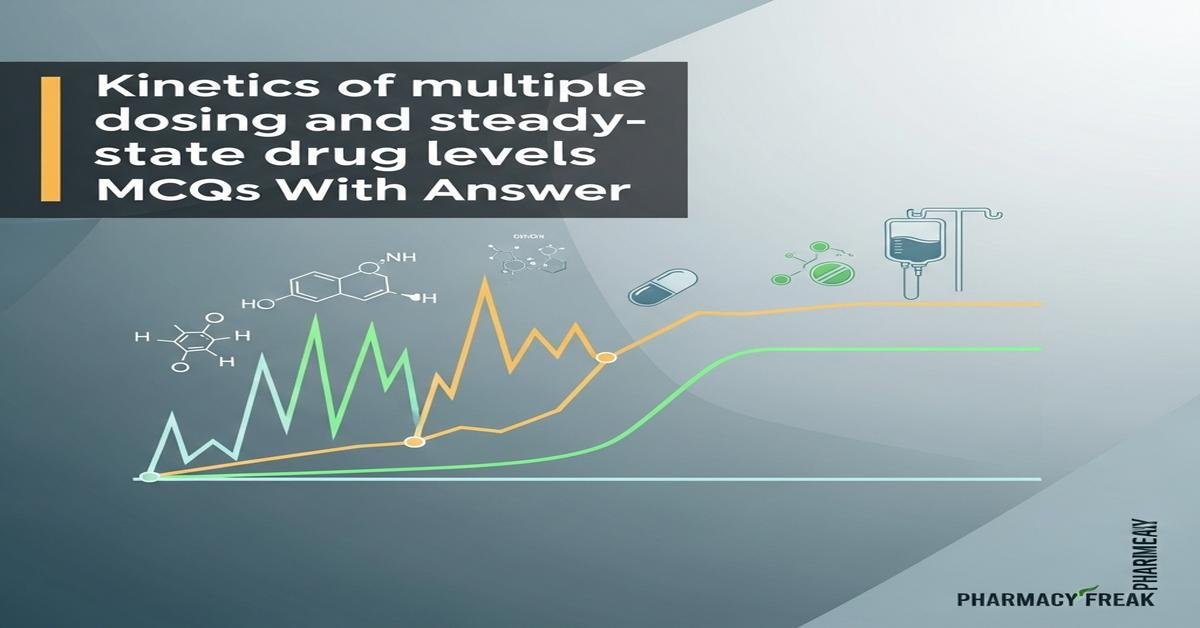
Kinetics of multiple dosing and steady-state drug levels is a vital pharmacokinetics topic for B. Pharm students. This concise introduction covers accumulation, steady-state (Css), time to steady-state, and how half-life, clearance, volume of distribution, dosing interval, bioavailability, loading dose and maintenance dose interact. You will study key equations for loading dose, maintenance dose rate, accumulation ratio and peak–trough fluctuation, plus concepts like superposition, continuous infusion vs intermittent dosing, and nonlinear kinetics. Mastery of these principles is essential for rational regimen design and therapeutic drug monitoring. Now let’s test your knowledge with 30 MCQs on this topic.
Q1. What is the best definition of steady-state drug concentration (Css)?
- The plasma concentration after a single dose that does not change
- The concentration at which the rate of drug administration equals the rate of elimination
- The maximal concentration reached immediately after a bolus dose
- The concentration measured at the half-life time point
Correct Answer: The concentration at which the rate of drug administration equals the rate of elimination
Q2. Which primary pharmacokinetic parameter chiefly determines the time required to reach steady-state?
- Bioavailability (F)
- Elimination half-life (t1/2)
- Volume of distribution (Vd)
- Dose magnitude
Correct Answer: Elimination half-life (t1/2)
Q3. What is the correct formula for calculating an intravenous loading dose (LD) to rapidly achieve a target concentration?
- LD = (Target Css × Clearance) / Bioavailability
- LD = (Target Css × Volume of distribution) / Bioavailability
- LD = (Clearance × Dosing interval) / Target Css
- LD = (Target Css × Elimination rate constant)
Correct Answer: LD = (Target Css × Volume of distribution) / Bioavailability
Q4. Which expression gives the maintenance dosing rate (rate in) to maintain a target steady-state concentration?
- Maintenance rate = (Target Css × Volume of distribution) / Bioavailability
- Maintenance rate = (Target Css × Clearance) / Bioavailability
- Maintenance rate = (Dose / Dosing interval) × Bioavailability
- Maintenance rate = (Elimination rate constant × Volume of distribution) / Target Css
Correct Answer: Maintenance rate = (Target Css × Clearance) / Bioavailability
Q5. For first-order elimination with intermittent dosing, which formula describes the accumulation ratio (Racc)?
- Racc = 1 – e^(-k·τ)
- Racc = e^(k·τ)
- Racc = 1 / (1 – e^(-k·τ))
- Racc = k × τ
Correct Answer: Racc = 1 / (1 – e^(-k·τ))
Q6. What is the main clinical effect of shortening the dosing interval while keeping the same total daily dose divided more frequently?
- Increase peak concentrations and increase fluctuation
- Lower peak concentrations and reduce peak–trough fluctuation
- Decrease average steady-state concentration
- Eliminate the need for monitoring
Correct Answer: Lower peak concentrations and reduce peak–trough fluctuation
Q7. Approximately how many half-lives are required to reach about 90–97% of steady-state for a drug with first-order kinetics?
- 1 half-life
- 2 half-lives
- 4–5 half-lives
- 10 half-lives
Correct Answer: 4–5 half-lives
Q8. The principle of superposition in multiple dosing pharmacokinetics assumes which condition?
- Drug elimination is zero-order and saturable
- Drug concentrations from each dose are independent and cannot be added
- Kinetics are linear (first-order), so concentrations from each dose add algebraically
- The drug has an extremely large volume of distribution only
Correct Answer: Kinetics are linear (first-order), so concentrations from each dose add algebraically
Q9. For a constant IV infusion, which relationship defines steady-state concentration?
- Css = Infusion rate / Clearance
- Css = Infusion rate × Volume of distribution
- Css = Bioavailability / Clearance
- Css = Dose / Dosing interval
Correct Answer: Css = Infusion rate / Clearance
Q10. Which statement is true about multiple dosing when elimination follows zero-order kinetics?
- Steady-state is reached in 4–5 half-lives exactly as in first-order kinetics
- Steady-state predictions using first-order equations are not accurate
- Accumulation is independent of dose magnitude
- Superposition principle applies without restrictions
Correct Answer: Steady-state predictions using first-order equations are not accurate
Q11. If a drug’s oral bioavailability decreases due to drug–drug interaction, what adjustment is usually required to maintain the same Css?
- Decrease maintenance dose
- Increase maintenance dose
- Shorten the half-life
- No change is ever required
Correct Answer: Increase maintenance dose
Q12. When should a trough concentration be sampled for therapeutic drug monitoring in multiple dosing?
- Immediately after a dose
- Midway between two doses
- Just before the next scheduled dose
- At any random time within the dosing interval
Correct Answer: Just before the next scheduled dose
Q13. To maintain safety and efficacy at steady-state, target Css should be kept between which limits?
- Below the minimum effective concentration (MEC)
- Between the minimum effective concentration (MEC) and maximum tolerated concentration (MTC)
- Always above the MTC to ensure efficacy
- Independent of MEC and MTC
Correct Answer: Between the minimum effective concentration (MEC) and maximum tolerated concentration (MTC)
Q14. In multi-compartment drugs, which half-life is most predictive of time to reach steady-state?
- The initial distribution half-life only
- The absorption half-life only
- The terminal or effective half-life
- Half-life is irrelevant for multi-compartment drugs
Correct Answer: The terminal or effective half-life
Q15. What is the main purpose of administering a loading dose before maintenance dosing?
- To prolong the drug half-life
- To achieve target therapeutic concentration rapidly
- To reduce clearance
- To prevent side effects entirely
Correct Answer: To achieve target therapeutic concentration rapidly
Q16. Peak–trough fluctuation during multiple dosing increases under which condition?
- Dosing interval much shorter than the half-life
- Dosing interval much longer than the half-life
- When bioavailability is 100%
- When clearance is constant
Correct Answer: Dosing interval much longer than the half-life
Q17. For intermittent oral dosing, which formula gives the average steady-state concentration (Css,avg)?
- Css,avg = (Dose × Bioavailability) / (Clearance × Dosing interval)
- Css,avg = (Dose × Clearance) / (Volume of distribution × Dosing interval)
- Css,avg = (Clearance × Dosing interval) / Dose
- Css,avg = Volume of distribution / Clearance
Correct Answer: Css,avg = (Dose × Bioavailability) / (Clearance × Dosing interval)
Q18. How does reduced renal clearance affect steady-state concentration for a renally eliminated drug when the same dosing regimen is continued?
- Css decreases and time to steady-state shortens
- Css increases and time to steady-state usually lengthens
- No change in Css but fluctuation increases
- Only distribution changes, not Css
Correct Answer: Css increases and time to steady-state usually lengthens
Q19. Splitting a fixed total daily dose into more frequent smaller doses (e.g., twice daily to four times daily) typically results in what change at steady-state?
- Higher peaks and lower troughs
- Lower peaks, higher troughs, and reduced fluctuation
- Lower average steady-state concentration
- Shorter half-life
Correct Answer: Lower peaks, higher troughs, and reduced fluctuation
Q20. Which factor does NOT change the theoretical average steady-state concentration if maintenance rate is kept constant?
- Clearance (CL)
- Dosing interval when rate is adjusted to keep the same maintenance rate
- Bioavailability (F)
- Infusion rate for continuous infusion when unchanged
Correct Answer: Dosing interval when rate is adjusted to keep the same maintenance rate
Q21. After stopping multiple dosing of a drug with first-order kinetics, how long until the drug is effectively eliminated (to negligible levels)?
- About 1 half-life
- About 2 half-lives
- About 4–5 half-lives
- Immediate elimination
Correct Answer: About 4–5 half-lives
Q22. Under what dosing condition is accumulation most likely to occur?
- Dosing interval much longer than the elimination half-life
- Dosing interval shorter than or comparable to the elimination half-life
- When bioavailability is zero
- When clearance increases dramatically
Correct Answer: Dosing interval shorter than or comparable to the elimination half-life
Q23. For a continuous IV infusion, which action will immediately change the steady-state concentration once a new steady-state is reached?
- Changing the infusion rate
- Changing the volume of distribution instantaneously
- Changing the terminal half-life instantly
- Changing the drug’s chemical structure
Correct Answer: Changing the infusion rate
Q24. The peak-to-trough ratio at steady-state for first-order intermittent dosing is mathematically related to which parameters?
- Only bioavailability
- Elimination rate constant (k) and dosing interval (τ)
- Volume of distribution only
- Clearance and infusion rate only
Correct Answer: Elimination rate constant (k) and dosing interval (τ)
Q25. In multi-compartment kinetics, why is the concept of effective half-life important for multiple dosing?
- Because it equals the absorption half-life always
- Because it predicts the true time course of accumulation and time to steady-state better than the terminal half-life alone
- Because it eliminates the need to know clearance
- Because it is independent of dosing interval
Correct Answer: Because it predicts the true time course of accumulation and time to steady-state better than the terminal half-life alone
Q26. Which parameter is directly proportional to the loading dose required to rapidly achieve a target concentration?
- Clearance (CL)
- Volume of distribution (Vd)
- Elimination rate constant (k)
- Bioavailability only when intravenous administration
Correct Answer: Volume of distribution (Vd)
Q27. What is the formula for the maintenance dose per dosing interval (Dmaintenance) to achieve target Css for oral dosing?
- Dmaintenance = (Target Css × Clearance × Dosing interval) / Bioavailability
- Dmaintenance = (Target Css × Volume of distribution) / Bioavailability
- Dmaintenance = (Clearance × Volume of distribution) / Target Css
- Dmaintenance = (Dose × Bioavailability) / Clearance
Correct Answer: Dmaintenance = (Target Css × Clearance × Dosing interval) / Bioavailability
Q28. If a continuous infusion produces the same total drug input per day as an equivalent intermittent regimen, how do their average steady-state concentrations compare?
- The infusion produces a lower average Css
- The intermittent regimen produces a higher average Css
- The average Css values are equivalent if total input and clearance are the same
- They cannot be compared
Correct Answer: The average Css values are equivalent if total input and clearance are the same
Q29. How does nonlinear (saturable) pharmacokinetics affect accumulation during multiple dosing?
- Accumulation follows the same predictable linear equations as first-order kinetics
- Accumulation becomes dose-dependent and less predictable because clearance may change with concentration
- There is no accumulation at all
- Half-life becomes irrelevant but accumulation remains linear
Correct Answer: Accumulation becomes dose-dependent and less predictable because clearance may change with concentration
Q30. Which trend correctly describes how the accumulation factor changes when the elimination half-life increases while keeping the dosing interval constant?
- The accumulation factor decreases as half-life increases
- The accumulation factor remains unchanged
- The accumulation factor increases as half-life increases
- The accumulation factor becomes negative
Correct Answer: The accumulation factor increases as half-life increases


