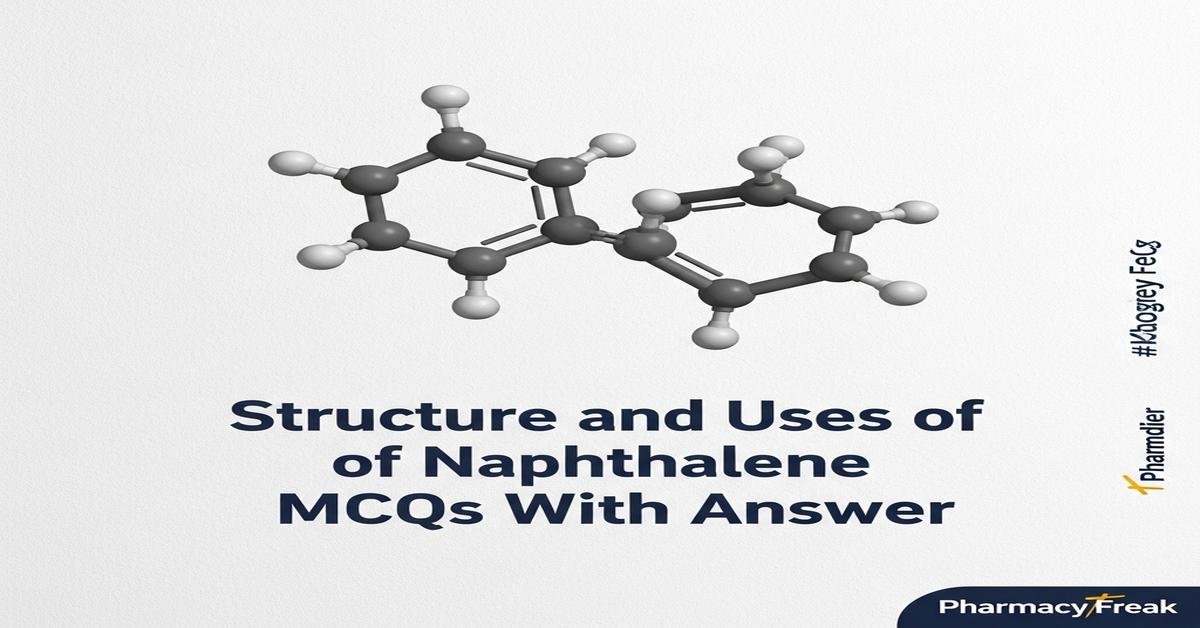
Understanding the structure and uses of naphthalene is essential for B.Pharm students studying aromatic hydrocarbons, medicinal chemistry and pharmaceutical synthesis. This introduction covers core topics such as the molecular formula, fused-ring aromaticity, resonance stabilization, alpha/beta positions, common reactions (nitration, sulfonation, oxidation to phthalic anhydride), spectroscopy, and key pharmaceutical and industrial applications. Emphasis is placed on how naphthalene derivatives function as intermediates in dye and drug synthesis, their physicochemical properties, and safety/toxicity concerns relevant to formulation and handling. The content is tailored to exam preparation and practical lab contexts, with focused keywords like structure of naphthalene, uses of naphthalene, naphthalene MCQs, and B.Pharm students. Now let’s test your knowledge with 50 MCQs on this topic.
Q1. What is the molecular formula of naphthalene?
- C8H8
- C10H8
- C12H10
- C6H6
Correct Answer: C10H8
Q2. Which description best explains naphthalene’s aromaticity?
- Single benzene ring with alternating double bonds
- Two fused benzene rings sharing two carbon atoms with 10 π-electrons fulfilling Hückel’s rule
- Saturated bicyclic alkane with no conjugation
- Non-aromatic polyene chain
Correct Answer: Two fused benzene rings sharing two carbon atoms with 10 π-electrons fulfilling Hückel’s rule
Q3. Which positions on the naphthalene ring are referred to as “alpha” positions?
- Carbon atoms adjacent to the fusion point (1 and 4 positions)
- Carbon atoms next to the fusion point (1 and 2 positions)
- Carbon atoms at the far ends of each ring (5 and 8 positions)
- Only the fusion carbons
Correct Answer: Carbon atoms next to the fusion point (1 and 2 positions)
Q4. Which statement about electrophilic substitution on naphthalene is correct?
- Beta positions are generally more reactive than alpha positions
- Alpha positions are more reactive in electrophilic substitution due to more stable arenium intermediates
- Both alpha and beta positions react equally
- Naphthalene does not undergo electrophilic substitution
Correct Answer: Alpha positions are more reactive in electrophilic substitution due to more stable arenium intermediates
Q5. The major product of monosubstitution of naphthalene under kinetic control is usually at which position?
- Beta (2-) position
- Alpha (1-) position
- Fusion carbon
- Any random position
Correct Answer: Alpha (1-) position
Q6. Oxidation of naphthalene with chromic acid predominantly yields which compound?
- Benzoic acid
- Phthalic anhydride
- Terephthalic acid
- Naphthol
Correct Answer: Phthalic anhydride
Q7. Which reagent is commonly used for nitration of naphthalene in laboratory conditions?
- HNO3 + H2SO4 (mixed acid)
- KMnO4
- NaBH4
- LiAlH4
Correct Answer: HNO3 + H2SO4 (mixed acid)
Q8. Which infrared (IR) absorption is characteristic of aromatic C–H stretching in naphthalene?
- ~3300 cm−1
- ~3000–3100 cm−1
- ~1700 cm−1
- ~2100 cm−1
Correct Answer: ~3000–3100 cm−1
Q9. What is the IUPAC preferred numbering for the most common monosubstituted naphthalene to give the substituent lowest possible number?
- Start numbering at any carbon
- Number so that substituent is at C-1 (alpha) where possible
- Always place substituent at C-4
- Number across the ring to give highest numbers
Correct Answer: Number so that substituent is at C-1 (alpha) where possible
Q10. Which spectroscopic technique is most useful to distinguish 1-naphthol from 2-naphthol?
- UV-Vis only
- 1H NMR chemical shifts and coupling patterns
- Mass spectrometry only
- Thin layer chromatography only
Correct Answer: 1H NMR chemical shifts and coupling patterns
Q11. Which statement about resonance energy of naphthalene compared to benzene is correct?
- Naphthalene has higher resonance energy per π electron than benzene
- Naphthalene has lower resonance energy per π electron than benzene but greater total resonance energy
- Naphthalene has no resonance stabilization
- Resonance energy cannot be compared between polycyclic aromatics
Correct Answer: Naphthalene has lower resonance energy per π electron than benzene but greater total resonance energy
Q12. Which naphthalene derivative is an important intermediate for dye and pigment industries?
- 1-Naphthol and 2-naphthol
- Cyclohexane
- Phenol
- Toluene
Correct Answer: 1-Naphthol and 2-naphthol
Q13. Naphthalene is commonly used in industry as:
- An antioxidant in polymerization reactions
- A moth repellant and insecticide
- A food preservative
- A primary solvent for polar compounds
Correct Answer: A moth repellant and insecticide
Q14. Which product forms on sulfonation of naphthalene under mild conditions (room temperature)?
- 2-Naphthalenesulfonic acid (beta sulfonation)
- 1-Naphthalenesulfonic acid (alpha sulfonation)
- Phthalic acid
- Naphthol
Correct Answer: 1-Naphthalenesulfonic acid (alpha sulfonation)
Q15. In electrophilic substitution, why is the 1-position favored kinetically over the 2-position?
- Because the intermediate carbocation at 1-position is less stabilized
- Because substitution at 1-position leads to more resonance-stabilized arenium ions and lower activation energy
- Because steric hindrance prevents reaction at 1-position
- Because 2-position is deactivated by resonance
Correct Answer: Because substitution at 1-position leads to more resonance-stabilized arenium ions and lower activation energy
Q16. Which method is commonly used to prepare naphthalene industrially?
- Coal tar distillation and extraction
- Direct hydrogenation of benzene
- Electrochemical synthesis from ethylene
- Fermentation
Correct Answer: Coal tar distillation and extraction
Q17. Which naphthalene derivative is directly produced by oxidation of the methyl side chain (if a methyl-substituted naphthalene is oxidized)?
- Benzoic acid
- Phthalic acid or phthalic anhydride (depending on substitution)
- Phenol
- Acetic acid
Correct Answer: Phthalic acid or phthalic anhydride (depending on substitution)
Q18. Which of these is a common hazard associated with naphthalene exposure relevant to pharmacy labs?
- Hypoglycemia
- Hemolytic anemia and methemoglobinemia, especially in G6PD-deficient individuals
- Immediate skin tanning
- Immunization requirement
Correct Answer: Hemolytic anemia and methemoglobinemia, especially in G6PD-deficient individuals
Q19. Which NMR feature helps identify naphthalene’s aromatic protons?
- Signals between 0–1 ppm
- Multiple aromatic proton signals typically between 7–8.5 ppm with characteristic coupling patterns
- Single sharp singlet at 10 ppm
- No signals, as naphthalene is NMR inactive
Correct Answer: Multiple aromatic proton signals typically between 7–8.5 ppm with characteristic coupling patterns
Q20. Which reagent is used to convert naphthalene to 1-naphthol via electrophilic substitution and subsequent hydrolysis?
- Nitric acid directly
- Sulfuric acid alone
- Halogenation followed by hydrolysis (e.g., bromination then substitution)
- Hydrogenation
Correct Answer: Halogenation followed by hydrolysis (e.g., bromination then substitution)
Q21. Which statement about substitution directing effects of naphthyl substituents is true?
- A substituent at 1-position directs incoming electrophiles only to remote positions
- Electron-donating groups generally activate the ring and direct to ortho/para (alpha) positions
- Electron-withdrawing groups always activate the ring
- Directing effects in naphthalene are identical to aliphatic systems
Correct Answer: Electron-donating groups generally activate the ring and direct to ortho/para (alpha) positions
Q22. Which isomer of naphthol is generally more acidic and why?
- 2-Naphthol is more acidic due to better resonance stabilization of the conjugate base
- 1-Naphthol is more acidic due to steric hindrance
- Both have identical acidity
- Naphthol is not acidic
Correct Answer: 2-Naphthol is more acidic due to better resonance stabilization of the conjugate base
Q23. In medicinal chemistry, naphthalene rings in drug molecules primarily influence which property?
- Aqueous solubility (always increases it)
- Lipophilicity and membrane permeability
- Optical activity (chirality)
- Direct pharmacological activity in all cases
Correct Answer: Lipophilicity and membrane permeability
Q24. Which reagent and condition favor beta (2-) substitution on naphthalene (thermodynamic product)?
- Low temperature, kinetically controlled
- High temperature, allowing equilibration to 2-substituted (thermodynamic) products
- Dilute acid at 0°C
- Photochemical conditions only
Correct Answer: High temperature, allowing equilibration to 2-substituted (thermodynamic) products
Q25. Which derivative is formed when naphthalene is reduced by catalytic hydrogenation (full hydrogenation)?
- Cyclohexane
- Decalin (decahydronaphthalene)
- Biphenyl
- Tetralin only
Correct Answer: Decalin (decahydronaphthalene)
Q26. What is a common laboratory method to separate naphthalene from a mixture due to its physical properties?
- Distillation based on its relatively high vapor pressure and sublimation
- Centrifugation only
- Ion-exchange chromatography
- Simple filtration of aqueous solutions
Correct Answer: Distillation based on its relatively high vapor pressure and sublimation
Q27. Which metabolic pathway is most relevant for naphthalene toxicity in humans?
- Oxidation by cytochrome P450 to reactive epoxides and quinones leading to oxidative stress
- Direct conjugation to glucose
- Deamination
- Direct excretion unchanged in urine only
Correct Answer: Oxidation by cytochrome P450 to reactive epoxides and quinones leading to oxidative stress
Q28. Which product results from catalytic hydrogenation of only one ring of naphthalene (partial hydrogenation)?
- Tetralin (1,2,3,4-tetrahydronaphthalene)
- Benzene
- Naphthalenediol
- Phenanthrene
Correct Answer: Tetralin (1,2,3,4-tetrahydronaphthalene)
Q29. Which of the following statements about phthalic anhydride produced from naphthalene is true?
- Phthalic anhydride is not related to any industrial applications
- It is a key intermediate for plasticizers (phthalate esters), dyes and pigments
- It is only used as a food additive
- It is mainly used as a fuel additive
Correct Answer: It is a key intermediate for plasticizers (phthalate esters), dyes and pigments
Q30. How does the UV-Vis absorption of naphthalene compare to benzene?
- Naphthalene shows no UV absorption
- Naphthalene absorbs at longer wavelengths (bathochromic shift) due to extended conjugation
- Benzene absorbs at longer wavelengths than naphthalene
- Both absorb identically
Correct Answer: Naphthalene absorbs at longer wavelengths (bathochromic shift) due to extended conjugation
Q31. Which stain or detection method is commonly used to visualize naphthyl derivatives in thin-layer chromatography (TLC)?
- UV light (254/365 nm) and specific spray reagents like diazonium salts for naphthols
- Only iodine chamber
- Nessler’s reagent
- Biuret reagent
Correct Answer: UV light (254/365 nm) and specific spray reagents like diazonium salts for naphthols
Q32. Which of the following is a pharmacologically relevant naphthalene-containing drug scaffold or derivative?
- Naftifine (an antifungal agent containing a naphthyl group)
- Penicillin core
- Metformin
- Aspirin
Correct Answer: Naftifine (an antifungal agent containing a naphthyl group)
Q33. Which condition favors formation of 1,4-addition products rather than electrophilic aromatic substitution on naphthalene?
- Strong electrophiles at low temperature only
- Under very vigorous, high-energy conditions leading to addition (e.g., catalytic hydrogenation or radical additions)
- Normal Friedel–Crafts conditions
- Presence of mild Lewis acids
Correct Answer: Under very vigorous, high-energy conditions leading to addition (e.g., catalytic hydrogenation or radical additions)
Q34. Which of the following is true about the bond lengths in naphthalene?
- All C–C bond lengths are identical as in benzene
- C–C bond lengths vary: bonds shared by two rings are shorter due to greater double-bond character
- All bonds are single bonds
- C–H bonds are longer than typical aromatic C–H
Correct Answer: C–C bond lengths vary: bonds shared by two rings are shorter due to greater double-bond character
Q35. Which mechanism predominates in the halogenation of naphthalene under Lewis acid catalysis?
- Nucleophilic aromatic substitution
- Electrophilic aromatic substitution via sigma complex (arenium ion)
- Radical substitution exclusively
- Pericyclic cycloaddition
Correct Answer: Electrophilic aromatic substitution via sigma complex (arenium ion)
Q36. Which isomer of naphthalene sulfonic acid is more commonly formed at higher temperatures (thermodynamic control)?
- 1-Naphthalenesulfonic acid
- 2-Naphthalenesulfonic acid
- 3-Naphthalenesulfonic acid
- No sulfonation occurs at high temperature
Correct Answer: 2-Naphthalenesulfonic acid
Q37. Which factor most strongly influences site selectivity in naphthalene electrophilic substitution?
- Steric bulk of incoming electrophile only
- Resonance stabilization of the intermediate sigma complex and relative transition-state energies
- Solubility only
- Presence of metal catalysts only
Correct Answer: Resonance stabilization of the intermediate sigma complex and relative transition-state energies
Q38. Which laboratory safety precaution is most important when handling naphthalene powder in a B.Pharm lab?
- Use of fume hood, gloves, and avoiding inhalation or prolonged skin contact
- Always heat it to high temperature
- Store in open containers to allow ventilation
- No special precautions required
Correct Answer: Use of fume hood, gloves, and avoiding inhalation or prolonged skin contact
Q39. Which reagent is appropriate for converting 1-naphthol to 1-naphthyl ether (O-alkylation)?
- Strong base such as NaH followed by alkyl halide (Williamson ether synthesis)
- Hydrogen peroxide only
- Conc. H2SO4 only
- KMnO4
Correct Answer: Strong base such as NaH followed by alkyl halide (Williamson ether synthesis)
Q40. Which environmental concern is associated with naphthalene release?
- It rapidly biodegrades with no effects
- Air and water contamination with potential toxicity to aquatic life and humans; persistence in sediments
- It increases soil fertility
- It neutralizes other pollutants
Correct Answer: Air and water contamination with potential toxicity to aquatic life and humans; persistence in sediments
Q41. Which type of isomerism do 1- and 2-naphthol represent?
- Stereoisomerism
- Position (positional) isomerism
- Geometric isomerism
- Optical isomerism
Correct Answer: Position (positional) isomerism
Q42. Which catalyst is commonly used for hydrogenation of naphthalene to tetralin or decalin?
- Pd/C or Pt catalysts under hydrogen pressure
- MnO2
- KMnO4
- Conc. HCl
Correct Answer: Pd/C or Pt catalysts under hydrogen pressure
Q43. Which reaction converts naphthalene to naphthylamine derivatives used in dye chemistry?
- Reduction of nitronaphthalene (from nitration) followed by further functionalization
- Direct amination without prior functionalization
- Oxidation to phthalic anhydride then amination
- Hydrogenolysis only
Correct Answer: Reduction of nitronaphthalene (from nitration) followed by further functionalization
Q44. When considering UV spectroscopy, which transition is primarily responsible for naphthalene’s absorptions?
- n→π* transitions only
- π→π* transitions of the conjugated aromatic system
- σ→σ* transitions only
- Charge-transfer from solvent
Correct Answer: π→π* transitions of the conjugated aromatic system
Q45. Which of the following best describes the heat of hydrogenation of naphthalene compared to two isolated benzene rings?
- Equal to two benzene rings
- Less exothermic than hydrogenation of two isolated benzene rings, indicating aromatic stabilization in naphthalene
- More exothermic than two benzene rings
- Impossible to measure
Correct Answer: Less exothermic than hydrogenation of two isolated benzene rings, indicating aromatic stabilization in naphthalene
Q46. Which analytical property helps quantify naphthalene in pharmaceutical or environmental samples?
- Thin-layer chromatography only
- Gas chromatography (GC) often coupled with mass spectrometry (GC-MS)
- Only titration methods
- Colorimetric glucose tests
Correct Answer: Gas chromatography (GC) often coupled with mass spectrometry (GC-MS)
Q47. Which functional group on naphthalene greatly increases its water solubility and is commonly used in surfactant or dye chemistry?
- Alkyl chain
- Sulfonic acid group (–SO3H)
- tert-Butyl group
- Methyl group
Correct Answer: Sulfonic acid group (–SO3H)
Q48. Which statement about electrophilic aromatic substitution rate of naphthalene vs. benzene is correct?
- Naphthalene is generally more reactive than benzene at its alpha positions
- Naphthalene is always less reactive than benzene at all positions
- Benzene reacts faster in all electrophilic substitutions
- They have identical reactivity
Correct Answer: Naphthalene is generally more reactive than benzene at its alpha positions
Q49. For synthesis of 1-naphthylamine from naphthalene, which sequence is most appropriate?
- Oxidation to phthalic anhydride then amination
- Nitration to nitronaphthalene followed by reduction to naphthylamine
- Direct substitution with ammonia under mild conditions
- Halogenation followed by elimination
Correct Answer: Nitration to nitronaphthalene followed by reduction to naphthylamine
Q50. In drug formulation development, what is a major consideration when using naphthalene-containing excipients or actives?
- They are always water-soluble and require no solubilizers
- Potential toxicity, volatility, and interaction with other components due to high lipophilicity and possible metabolites
- They render formulations non-bioavailable by default
- They are inert and require no regulatory oversight
Correct Answer: Potential toxicity, volatility, and interaction with other components due to high lipophilicity and possible metabolites


