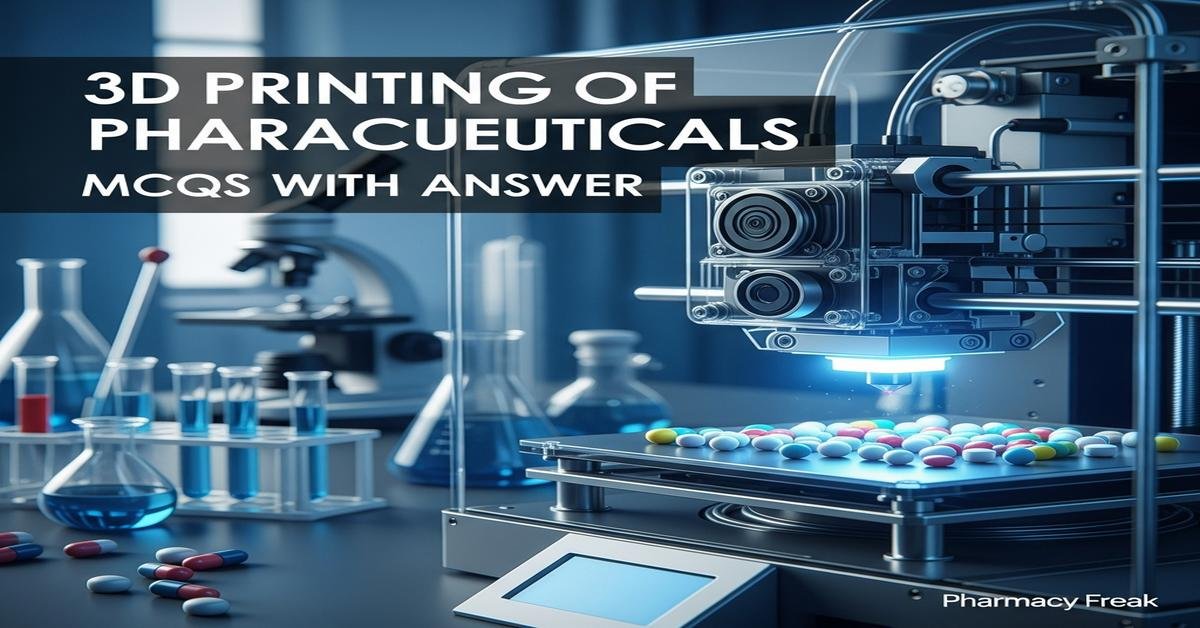
3D Printing of Pharmaceuticals MCQs With Answer helps M. Pharm students master an evolving area of drug delivery where dosage forms are built layer-by-layer with precision. This quiz explores key technologies such as fused deposition modeling (FDM), binder jetting, stereolithography (SLA/DLP), selective laser sintering (SLS), and semi-solid extrusion. You will assess material selection (polymers, plasticizers, photopolymers), process parameters (infill, layer height, laser power, binder saturation), quality attributes (porosity, strength, dissolution), design workflows (CAD–STL–G-code), and regulatory/PAT considerations for personalized medicines. The questions are application-focused—linking process choices to performance, stability, and safety—to prepare you for research and practice in patient-centric, on-demand manufacturing of tablets, films, and implants.
Q1. Which was the first FDA-approved 3D-printed oral solid dosage form and by which technology was it manufactured?
- Spritam (levetiracetam), produced by binder jetting (ZipDose)
- Spritam (levetiracetam), produced by fused deposition modeling (FDM)
- Onpattro (patisiran), produced by inkjet printing
- Abilify MyCite (aripiprazole), produced by stereolithography (SLA)
Correct Answer: Spritam (levetiracetam), produced by binder jetting (ZipDose)
Q2. Which 3D printing method builds dosage forms by extruding a thermoplastic filament through a heated nozzle?
- Fused deposition modeling (FDM)
- Selective laser sintering (SLS)
- Stereolithography (SLA/DLP)
- Binder jetting
Correct Answer: Fused deposition modeling (FDM)
Q3. In FDM-printed tablets, what is the most likely effect of increasing infill density and shell thickness?
- Higher porosity and faster disintegration
- Lower porosity and slower dissolution
- No change in mechanical strength
- Lower friability and faster disintegration
Correct Answer: Lower porosity and slower dissolution
Q4. For inkjet printing of drug-loaded inks onto oral films, which approximate viscosity window is generally acceptable for stable jetting?
- 0.01–0.1 mPa·s
- 1–20 mPa·s
- 50–200 mPa·s
- 500–2000 mPa·s
Correct Answer: 1–20 mPa·s
Q5. Which polymer is most suitable as a base filament for FDM printing without extensive plasticization?
- Polylactic acid (PLA)
- Hydroxypropyl methylcellulose (HPMC)
- Gelatin
- Sodium alginate
Correct Answer: Polylactic acid (PLA)
Q6. What is the principal safety concern requiring stringent control in stereolithography (SLA/DLP)-printed pharmaceutical dosage forms?
- Metal contamination from nozzle wear
- Residual photoinitiators and unreacted monomers causing toxicity
- Electrostatic charging of powder leading to dose variation
- High moisture uptake during printing
Correct Answer: Residual photoinitiators and unreacted monomers causing toxicity
Q7. In binder jetting of tablets, which parameter most directly governs tablet strength and dose uniformity?
- Layer thickness
- Recoater speed
- Binder saturation (binder-to-powder ratio)
- Build plate temperature
Correct Answer: Binder saturation (binder-to-powder ratio)
Q8. Which design strategy best enables pulsatile or sequential drug release in a 3D-printed “polypill”?
- Using a single polymer with uniform infill
- Segregated compartments printed with polymers of different solubility/erosion rates
- Increasing overall shell thickness uniformly
- Printing at a higher nozzle temperature
Correct Answer: Segregated compartments printed with polymers of different solubility/erosion rates
Q9. Which 3D printing approach is most suitable for thermolabile drugs (e.g., peptides) to avoid thermal degradation?
- Fused deposition modeling (FDM)
- Selective laser sintering (SLS)
- Stereolithography (SLA/DLP)
- Semi-solid extrusion (paste-based) at ambient/low temperature
Correct Answer: Semi-solid extrusion (paste-based) at ambient/low temperature
Q10. Which sequence correctly matches key digital files from design to print in pharmaceutical 3D printing?
- CAD model → OBJ → STEP
- CAD model → STL → G-code
- CAD model → DICOM → NC code
- CAD model → PDF → G-code
Correct Answer: CAD model → STL → G-code
Q11. Which change is most likely to increase tensile strength of FDM-printed tablets?
- Increase layer height and use a single raster angle
- Decrease layer height and use alternating raster angles (e.g., 0/90°)
- Reduce nozzle temperature and decrease infill
- Increase print speed and reduce shell thickness
Correct Answer: Decrease layer height and use alternating raster angles (e.g., 0/90°)
Q12. Which process analytical technology (PAT) tool is most appropriate for non-destructive, rapid assessment of API content uniformity in 3D-printed tablets?
- Thermogravimetric analysis (TGA)
- Near-infrared (NIR) spectroscopy
- High-performance liquid chromatography (HPLC)
- Differential scanning calorimetry (DSC)
Correct Answer: Near-infrared (NIR) spectroscopy
Q13. What is a primary manufacturing bottleneck when implementing on-demand personalized tablets in a hospital pharmacy using 3D printing?
- Lack of pharmacopeial monographs for common excipients
- Low throughput and long cycle time per unit
- Excessive heat generation in cleanrooms
- Inability to serialize individual doses
Correct Answer: Low throughput and long cycle time per unit
Q14. When designing an ODT by binder jetting for very rapid disintegration, which formulation/process choice is most appropriate?
- High binder saturation with microcrystalline cellulose only
- High-porosity matrix using mannitol plus a superdisintegrant (e.g., crospovidone) and lower binder saturation
- Low-porosity matrix with high lactose and no disintegrant
- Use of hydrophobic lubricants at high levels to enhance wetting
Correct Answer: High-porosity matrix using mannitol plus a superdisintegrant (e.g., crospovidone) and lower binder saturation
Q15. Which of the following is a critical quality attribute (CQA) directly linked to patient safety for 3D-printed tablets?
- Polygon count in the STL file
- Content uniformity
- Printer nozzle diameter
- Build plate size
Correct Answer: Content uniformity
Q16. To improve printability of Eudragit-based FDM filaments by lowering Tg and increasing flexibility, which plasticizer is commonly employed?
- Triethyl citrate
- Calcium stearate
- Colloidal silicon dioxide
- Sodium starch glycolate
Correct Answer: Triethyl citrate
Q17. In SLS printing of pharmaceutical tablets, which additive has been reported to facilitate laser absorption and improve sintering of powders?
- Titanium dioxide
- Microcrystalline cellulose
- Candurin gold shimmer (mica–TiO₂ pearlescent pigment)
- Talc
Correct Answer: Candurin gold shimmer (mica–TiO₂ pearlescent pigment)
Q18. Which approach is most compatible with achieving high drug loads (e.g., ≥50% w/w) in modified-release, matrix-type 3D-printed tablets?
- Material jetting of photopolymerizable drug monomers
- FDM using hot-melt-extruded, drug-loaded filaments
- Inkjet printing of dilute drug solutions onto inert substrates
- Binder jetting with very low powder bed porosity
Correct Answer: FDM using hot-melt-extruded, drug-loaded filaments
Q19. Which post-processing sequence is essential for SLA-printed pharmaceutical parts to minimize residual monomers?
- Thermal annealing only at 120°C
- Rinsing to remove uncured resin followed by UV post-curing
- Mechanical polishing followed by ethanol wipe
- Freeze-drying under vacuum
Correct Answer: Rinsing to remove uncured resin followed by UV post-curing
Q20. In drop-on-demand inkjet printing onto orodispersible films, which parameter is most practical to adjust for fine dose titration without changing film size?
- Nozzle diameter
- Number of printing passes (drop deposition density)
- Substrate thickness
- Drying oven temperature
Correct Answer: Number of printing passes (drop deposition density)


I am a Registered Pharmacist under the Pharmacy Act, 1948, and the founder of PharmacyFreak.com. I hold a Bachelor of Pharmacy degree from Rungta College of Pharmaceutical Science and Research. With a strong academic foundation and practical knowledge, I am committed to providing accurate, easy-to-understand content to support pharmacy students and professionals. My aim is to make complex pharmaceutical concepts accessible and useful for real-world application.
Mail- Sachin@pharmacyfreak.com