Table of Contents
Introduction
Senna is a stimulant laxative derived from the leaves and pods of Senna species plants. It is commonly used for short-term treatment of constipation and bowel evacuation before diagnostic procedures. Senna acts mainly in the colon by stimulating intestinal motility and increasing water secretion into the bowel lumen.
Mechanism of Action (Step-wise)
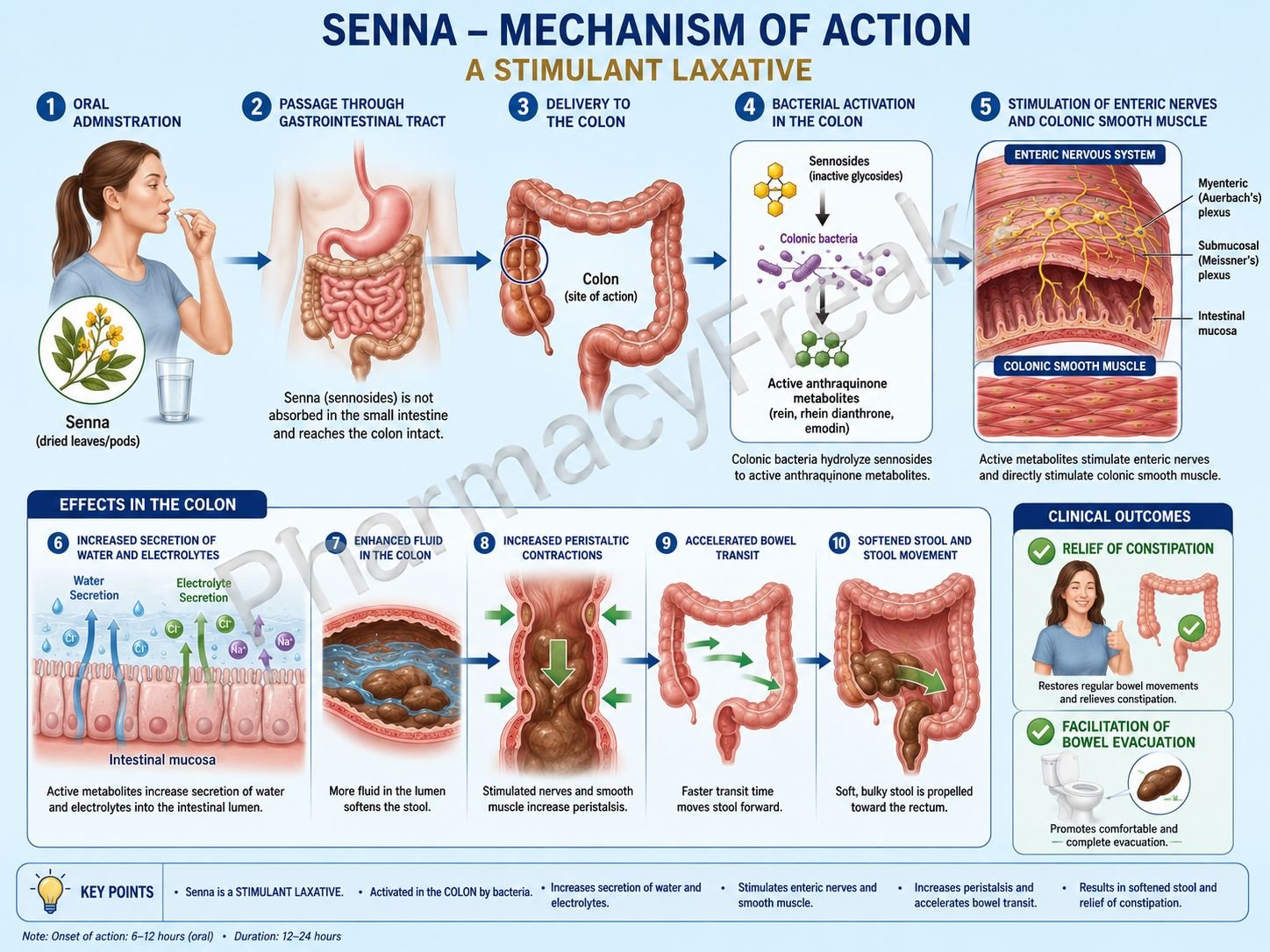
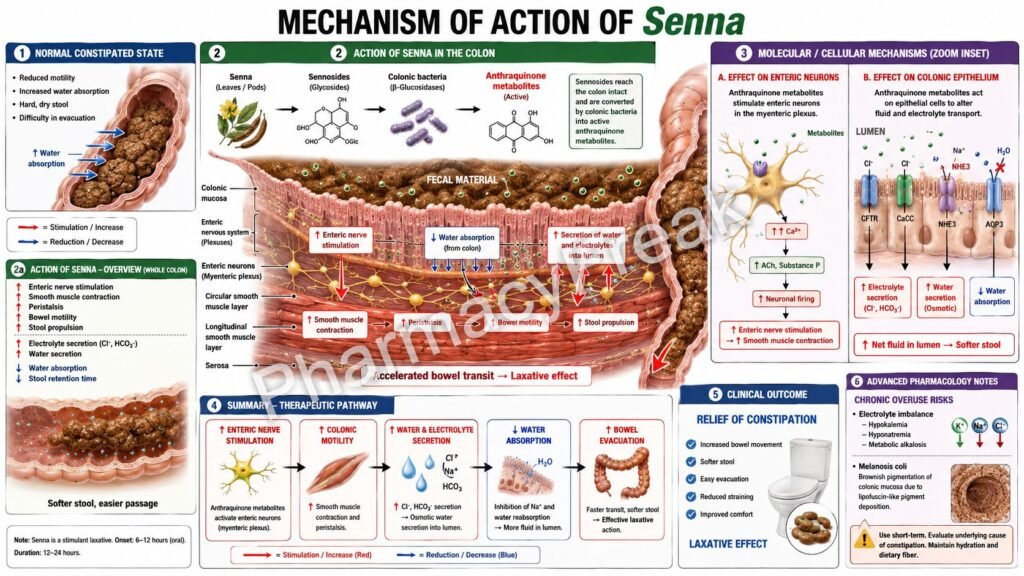
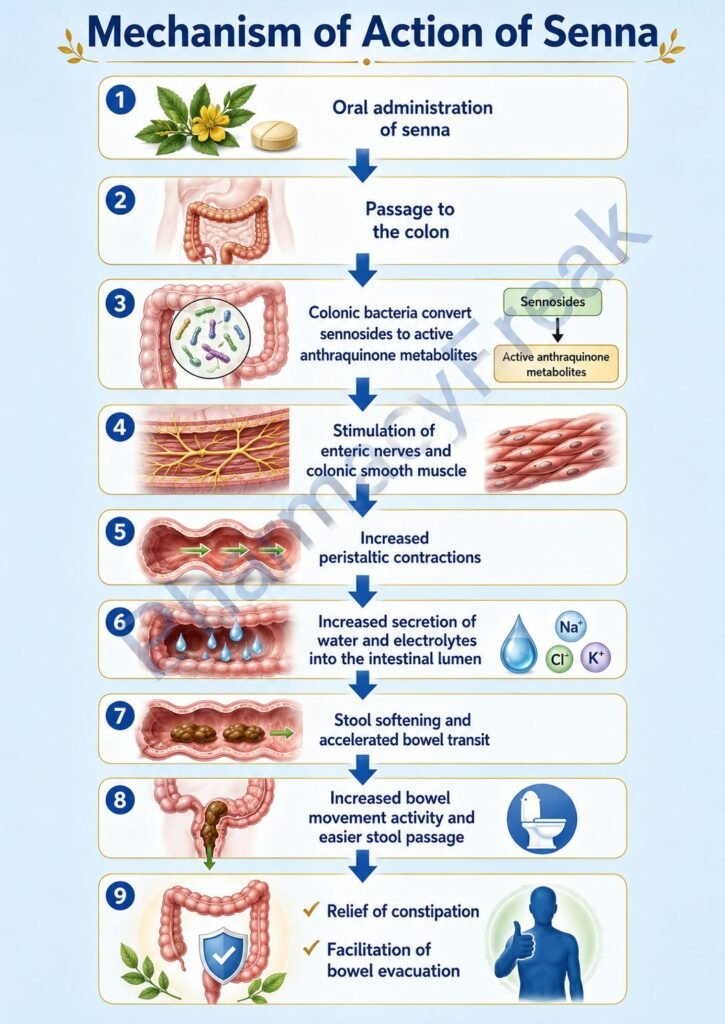
- Senna contains active compounds called sennosides.
- Sennosides are poorly absorbed in the small intestine.
- In the colon, intestinal bacteria convert sennosides into active metabolites such as rheinanthrone.
- These active metabolites irritate and stimulate the colonic mucosa.
- Stimulation of enteric nerves increases peristaltic contractions of the colon.
- Colonic transit time decreases.
- Senna also promotes secretion of water and electrolytes into the intestinal lumen.
- Fluid accumulation softens stool consistency.
- Increased intestinal motility and softer stool facilitate defecation.
- The overall effect is bowel evacuation and relief of constipation.
A key exam point is that senna stimulates colonic motility and increases water secretion through bacterial activation of sennosides in the colon.
Pharmacokinetics
Senna is administered orally. Its active sennosides reach the colon largely unchanged, where bacterial metabolism activates them. Onset of action usually occurs within 6 to 12 hours. Most metabolites are excreted through feces, with small amounts eliminated in urine.
Clinical Uses
Senna is used for short-term treatment of constipation and bowel preparation before surgery or diagnostic procedures such as colonoscopy.
Adverse Effects
Common adverse effects include abdominal cramps, diarrhea, nausea, and electrolyte imbalance with excessive use. Chronic overuse may lead to laxative dependence, hypokalemia, and melanosis coli.
Comparative Analysis
| Feature | Senna | Lactulose | Psyllium |
|---|---|---|---|
| Drug class | Stimulant laxative | Osmotic laxative | Bulk-forming laxative |
| Main mechanism | Stimulates colonic motility | Retains water osmotically | Increases stool bulk |
| Onset | 6–12 hours | 24–48 hours | 12–72 hours |
| Stool softening | Yes | Yes | Moderate |
| Cramping risk | Higher | Moderate | Low |
| Chronic use suitability | Limited | Better | Good |
Senna differs from lactulose and psyllium because it directly stimulates colonic nerves and intestinal motility rather than acting mainly through osmotic or bulk-forming mechanisms.
MCQs
- Senna belongs to which drug class?
a) Osmotic laxatives
b) Stimulant laxatives
c) Bulk-forming laxatives
d) Antidiarrheal drugs
Answer: b) Stimulant laxatives
- The active compounds in senna are called:
a) Alkaloids
b) Sennosides
c) Glycoproteins
d) Flavonoids only
Answer: b) Sennosides
- Sennosides are activated mainly in the:
a) Stomach
b) Colon
c) Liver
d) Pancreas
Answer: b) Colon
- Senna increases:
a) Colonic motility
b) Gastric acid secretion
c) Insulin release
d) Calcium absorption
Answer: a) Colonic motility
- Senna acts mainly by stimulating:
a) Enteric nerves
b) Dopamine receptors
c) Histamine receptors
d) β receptors
Answer: a) Enteric nerves
- Senna also increases intestinal secretion of:
a) Water and electrolytes
b) Histamine
c) Dopamine
d) Bile salts only
Answer: a) Water and electrolytes
- Senna is mainly used to treat:
a) Diarrhea
b) Constipation
c) Asthma
d) Hypertension
Answer: b) Constipation
- The usual onset of senna action is:
a) Within minutes
b) 6–12 hours
c) 3–5 days
d) 1 week
Answer: b) 6–12 hours
- A common adverse effect is:
a) Abdominal cramps
b) Severe bradycardia
c) Hypercalcemia
d) Cataracts
Answer: a) Abdominal cramps
- Chronic senna overuse may cause:
a) Hypokalemia
b) Hyperkalemia
c) Hyperglycemia
d) Polycythemia
Answer: a) Hypokalemia
- Senna differs from psyllium because senna mainly:
a) Increases stool bulk
b) Stimulates intestinal motility
c) Decreases water secretion
d) Blocks chloride channels
Answer: b) Stimulates intestinal motility
- Senna metabolites are formed by:
a) Hepatic enzymes
b) Colonic bacteria
c) Pancreatic enzymes
d) Gastric acid
Answer: b) Colonic bacteria
FAQs
What is the mechanism of action of senna?
Senna stimulates colonic motility and increases water secretion after bacterial activation of sennosides in the colon.
Why is senna considered a stimulant laxative?
Because it directly stimulates enteric nerves and intestinal contractions.
How long does senna take to work?
Usually 6 to 12 hours after oral administration.
What are common side effects of senna?
Abdominal cramps, diarrhea, and electrolyte imbalance.
Can senna be used long term?
Long-term overuse is not recommended because it may cause laxative dependence and hypokalemia.
How does senna differ from bulk-forming laxatives?
Senna stimulates motility, whereas bulk-forming agents mainly increase stool bulk.
References
Goodman & Gilman’s The Pharmacological Basis of Therapeutics – Drugs for Constipation and Diarrhea
https://accessmedicine.mhmedical.com/book.aspx?bookid=3191
Katzung: Basic and Clinical Pharmacology – Laxatives
https://accessmedicine.mhmedical.com/content.aspx?bookid=3382
Tripathi: Essentials of Medical Pharmacology – Drugs for Constipation
https://www.jaypeedigital.com
Harrison’s Principles of Internal Medicine – Gastrointestinal Disorders
https://accessmedicine.mhmedical.com