Table of Contents
Introduction
Scopolamine is an antimuscarinic drug primarily used for prevention of motion sickness and postoperative nausea and vomiting. It acts by blocking muscarinic acetylcholine receptors in the central and peripheral nervous systems. Scopolamine has significant effects on the vestibular system and vomiting center, making it especially useful in motion-related nausea.
Mechanism of Action (Step-wise)
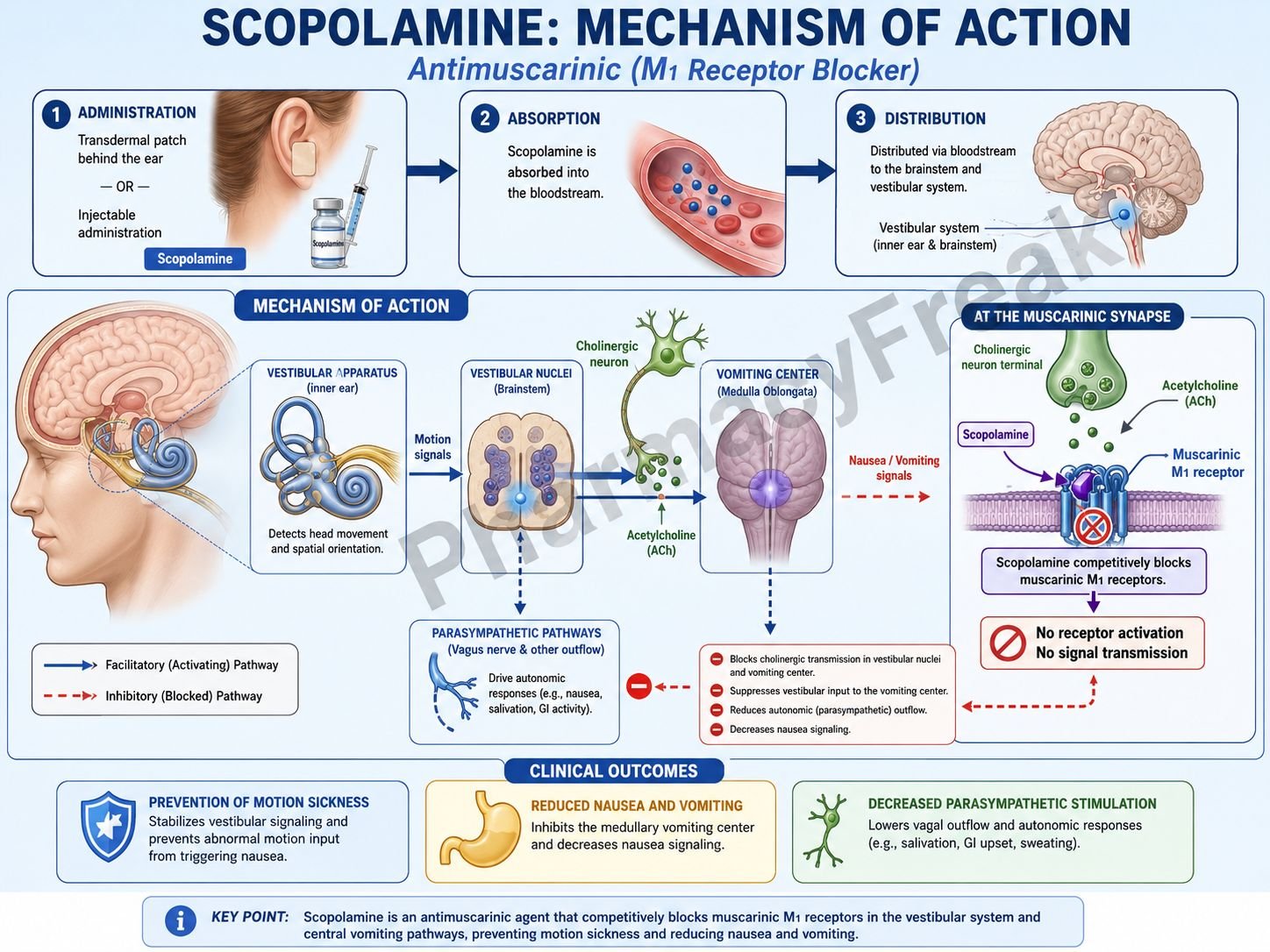
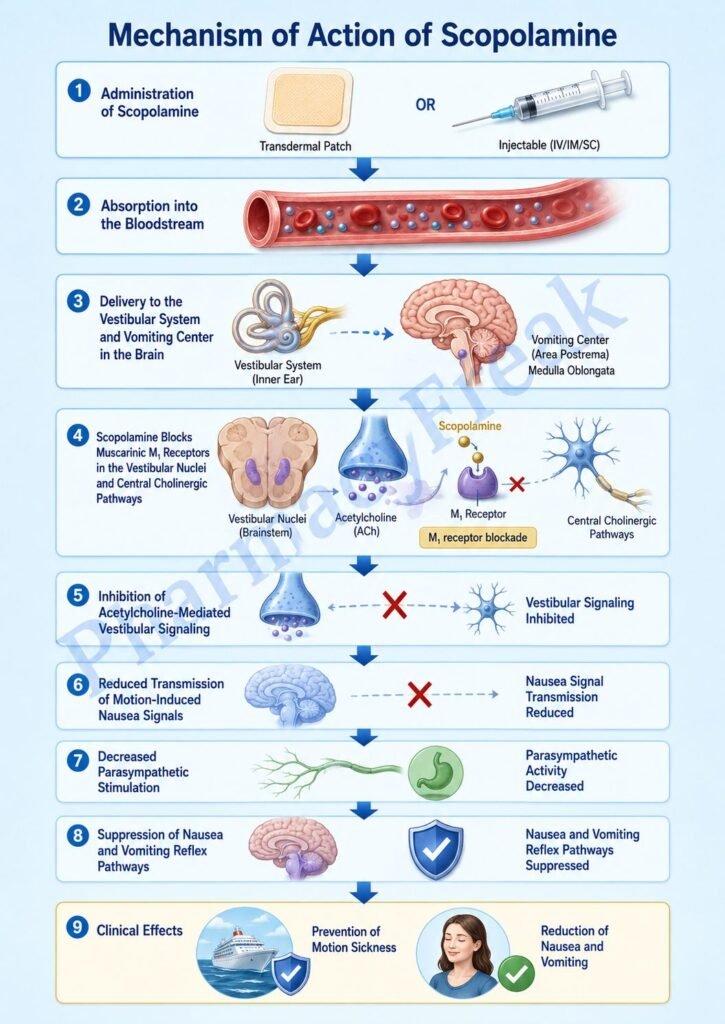
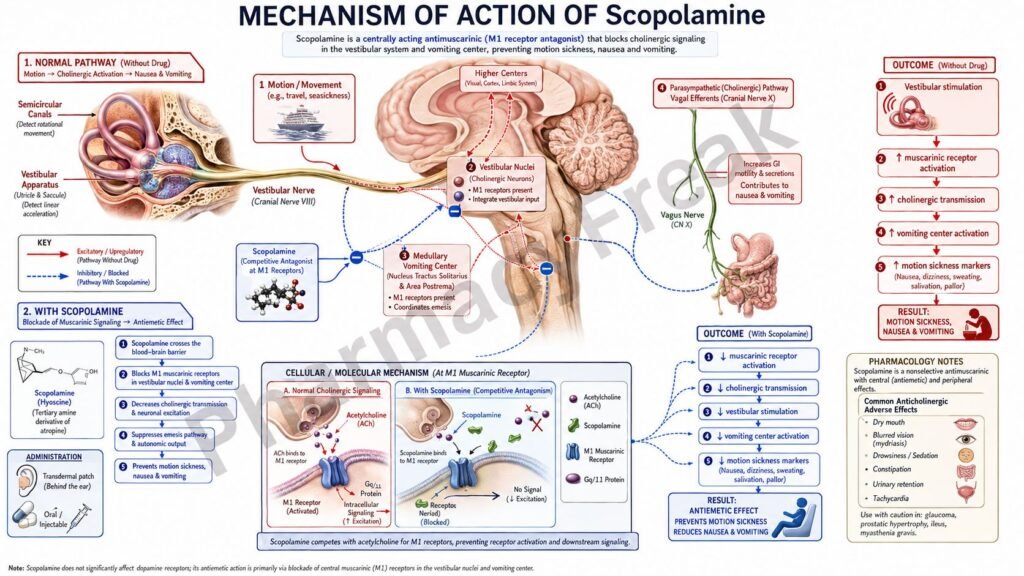
- Scopolamine competitively blocks muscarinic acetylcholine receptors (mainly M1 receptors).
- It acts in both the central nervous system and peripheral tissues.
- In the vestibular apparatus, acetylcholine normally transmits motion-related signals to the vomiting center.
- Scopolamine blocks cholinergic transmission from the vestibular nuclei to the cerebellum and vomiting center.
- This suppresses activation of the medullary vomiting center during motion stimulation.
- Nausea, vomiting, and dizziness associated with motion sickness decrease.
- In peripheral tissues, muscarinic receptor blockade reduces secretions from salivary and sweat glands.
- Smooth muscle tone in the gastrointestinal tract decreases.
- Pupillary dilation and cycloplegia may occur because of ocular muscarinic blockade.
- The overall effect is prevention of motion-induced nausea and reduction of parasympathetic activity.
A key exam point is that scopolamine blocks muscarinic receptors, especially in vestibular pathways involved in motion sickness.
Pharmacokinetics
Scopolamine can be administered orally, intravenously, or as a transdermal patch. The transdermal patch provides prolonged drug delivery and is commonly used for motion sickness prevention. Scopolamine crosses the blood-brain barrier and undergoes hepatic metabolism. Excretion occurs mainly through urine.
Clinical Uses
Scopolamine is mainly used for prevention of motion sickness and postoperative nausea and vomiting. It is also occasionally used to reduce secretions before surgery.
Adverse Effects
Common adverse effects include dry mouth, blurred vision, drowsiness, constipation, urinary retention, and tachycardia due to anticholinergic activity. CNS effects such as confusion and hallucinations may occur, especially in elderly patients.
Comparative Analysis
| Feature | Scopolamine | Atropine | Meclizine |
|---|---|---|---|
| Drug class | Antimuscarinic | Antimuscarinic | Antihistamine |
| Main use | Motion sickness | Bradycardia, organophosphate poisoning | Motion sickness |
| CNS penetration | High | Moderate | Moderate |
| Sedation | Moderate | Mild | Moderate |
| Dry mouth | Common | Common | Mild |
| Vestibular suppression | Strong | Moderate | Strong |
Scopolamine differs from atropine because it has greater CNS effects and stronger activity against motion sickness. Compared with meclizine, scopolamine acts mainly through muscarinic receptor blockade rather than histamine H1 receptor antagonism.
MCQs
- Scopolamine belongs to which drug class?
a) β blockers
b) Antimuscarinics
c) Antipsychotics
d) Antidepressants
Answer: b) Antimuscarinics
- Scopolamine primarily blocks which receptors?
a) Nicotinic receptors
b) Muscarinic receptors
c) Dopamine receptors
d) Histamine H2 receptors
Answer: b) Muscarinic receptors
- Scopolamine is mainly used to prevent:
a) Asthma
b) Motion sickness
c) Hypertension
d) Hyperthyroidism
Answer: b) Motion sickness
- Scopolamine acts strongly on which system involved in balance?
a) Auditory cortex
b) Vestibular system
c) Motor cortex
d) Limbic system
Answer: b) Vestibular system
- A common adverse effect is:
a) Excess salivation
b) Dry mouth
c) Bradycardia
d) Hypoglycemia
Answer: b) Dry mouth
- Scopolamine may cause:
a) Miosis
b) Mydriasis
c) Hypotension only
d) Hyperkalemia
Answer: b) Mydriasis
- The transdermal patch is commonly used for:
a) Hypertension
b) Motion sickness prevention
c) Diabetes mellitus
d) Peptic ulcer disease
Answer: b) Motion sickness prevention
- Scopolamine blocks mainly which muscarinic receptor subtype in the CNS?
a) M1
b) M2
c) M3
d) M4
Answer: a) M1
- Elderly patients may develop:
a) Hallucinations
b) Hypercalcemia
c) Severe hypertension
d) Cataracts
Answer: a) Hallucinations
- Compared with atropine, scopolamine has greater:
a) CNS effects
b) β blockade
c) Histamine release
d) Dopamine stimulation
Answer: a) CNS effects
- Scopolamine reduces parasympathetic activity by blocking effects of:
a) Dopamine
b) Acetylcholine
c) Histamine
d) Serotonin
Answer: b) Acetylcholine
- Scopolamine may decrease:
a) Salivary secretion
b) Blood glucose
c) Potassium excretion
d) Bone density
Answer: a) Salivary secretion
FAQs
What is the mechanism of action of scopolamine?
Scopolamine blocks muscarinic acetylcholine receptors, especially in vestibular pathways involved in motion sickness.
Why is scopolamine effective for motion sickness?
Because it suppresses cholinergic transmission from the vestibular system to the vomiting center.
What are common side effects of scopolamine?
Dry mouth, blurred vision, drowsiness, constipation, and urinary retention.
Why is scopolamine available as a transdermal patch?
To provide prolonged prevention of motion sickness with steady drug release.
How does scopolamine differ from antihistamines like meclizine?
Scopolamine works mainly through muscarinic receptor blockade, whereas meclizine mainly blocks histamine H1 receptors.
Can scopolamine cause CNS side effects?
Yes, confusion and hallucinations may occur, especially in elderly patients.
References
Goodman & Gilman’s The Pharmacological Basis of Therapeutics – Antimuscarinic Drugs
https://accessmedicine.mhmedical.com/book.aspx?bookid=3191
Katzung: Basic and Clinical Pharmacology – Cholinergic Antagonists
https://accessmedicine.mhmedical.com/content.aspx?bookid=3382
Tripathi: Essentials of Medical Pharmacology – Anticholinergic Drugs
https://www.jaypeedigital.com
Harrison’s Principles of Internal Medicine – Motion Sickness and Vestibular Disorders
https://accessmedicine.mhmedical.com